France and Germany strike deal to soften EU car emissions rules and open door for UK inclusion
A Franco-German compromise announced on Friday would keep the EU's 2035 CO2 target at 90 per cent but drop compensatory measures, and could extend 'Made in EU' procurement rules to Britain under strict conditions. The deal still needs backing from other member states and the European Parliament.
Synthesised from the cited sources. Research, writing and factual checks are automated using AI. Verify details against the sources. How we produce these reports
What France and Germany agreed
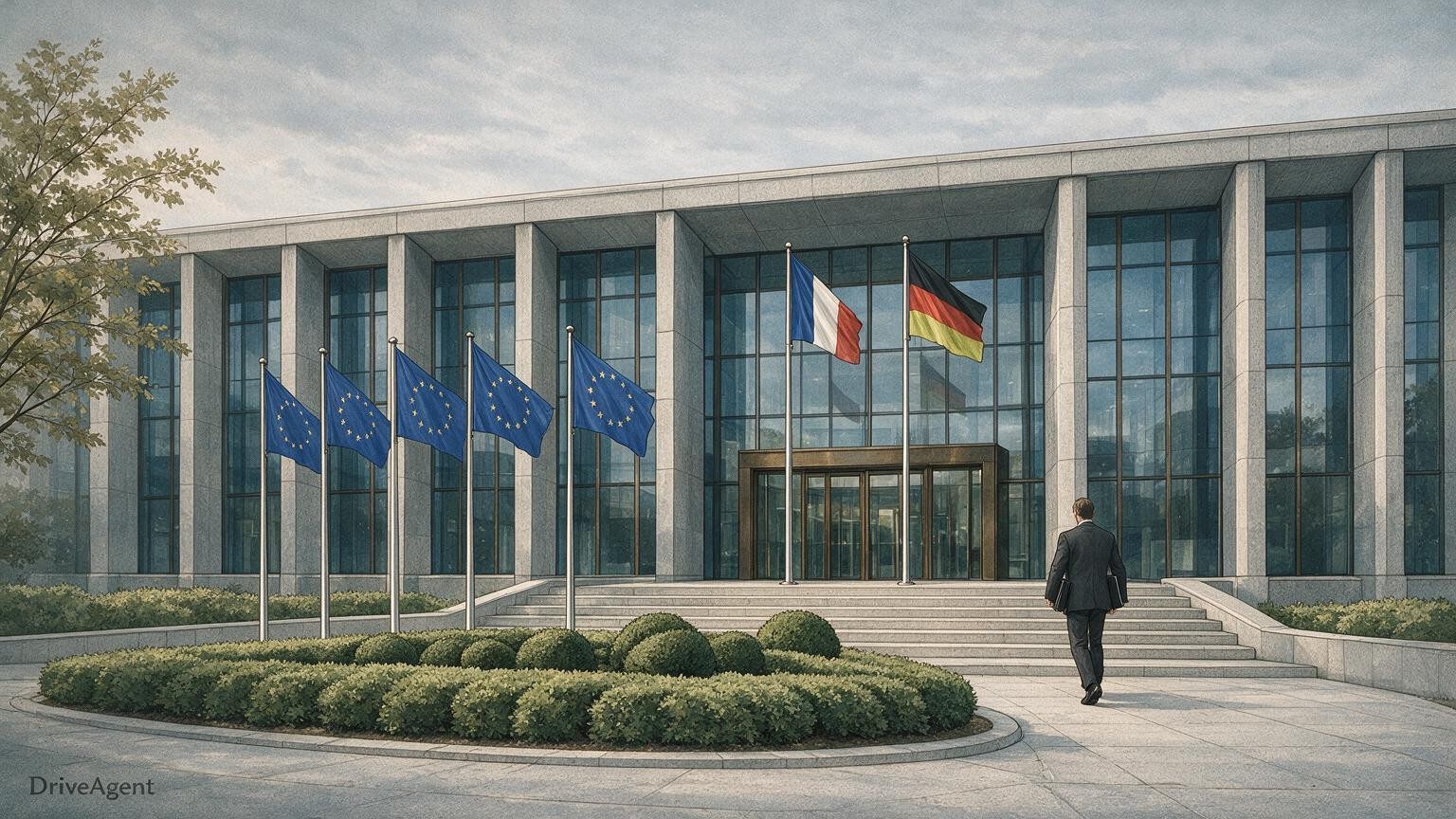
France and Germany confirmed on Friday, 16 October 2026, that they had reached a deal aimed at protecting Europe's automotive sector, agreeing on the two flashpoint issues of EU car emissions rules and 'Made in Europe' components, AFP reported from Brussels. German Chancellor Friedrich Merz called it 'a good day for motorists and for jobs in Germany, France and Europe', while French President Emmanuel Macron said the two countries were 'driven by a clear ambition: to successfully transform our automotive industry while maintaining our climate goals and our production in Europe'. 3
Paris and Berlin had previously been at odds over the direction of European policy for a sector that, as AFP noted, accounts for 13 million jobs and seven per cent of the bloc's GDP. Germany wanted less stringent carbon targets for carmakers and a broad interpretation of 'Made in Europe' that included key non-EU trade partners, while France had pushed to preserve the bloc's climate ambitions and restrict the public procurement scheme to EU nations. According to AFP, Berlin won the emissions argument and Paris carried the day on procurement eligibility. 3
The joint Franco-German statement described 'a comprehensive package that combines an ambitious European decarbonisation pathway with the regulatory flexibility needed to reflect different market realities and technological conditions', adding that it 'provides concrete incentives for investment, research and development, European production, and resilient supply chains', as reported by AFP. 3
The emissions compromise: 90 per cent, with fewer conditions
The European Commission had proposed last year that automakers cut CO2 emissions by 90 per cent from 2021 levels by 2035, with the remaining 10 per cent offset through measures such as low-carbon steel and alternative fuels. Under the Franco-German plan, Reuters reported, the 2035 target would remain at 90 per cent but without the need for those additional compensatory measures - an approach broadly in line with the wishes of German automakers. 2
The Londoner reported the same change from the opposite angle: the compensatory measures previously proposed by the Commission would have required manufacturers to address remaining emissions through approaches such as low-carbon steel or alternative fuels, and the revised approach is intended to give manufacturers greater flexibility while maintaining the headline reduction target. 1
Reuters additionally reported that the Franco-German paper proposed compliance periods spanning multiple years for CO2 targets, no revision before 2030 of the utility factor for hybrid vehicles - which measures the share of driving done electrically - and recognition of cars powered by renewable and low-carbon fuels as zero-emission vehicles. 2
Markets responded quickly. Reuters reported that European automotive stocks gained after the announcement, lifting the STOXX 600 Automobile and Parts Index nearly 2 per cent. 2
'Made in EU' and a possible route back for Britain
The Franco-German plan addresses an EU proposal introducing local-content and low-carbon requirements for products bought through public procurement, public auctions or subsidy schemes. France had pushed for these to be limited to EU-manufactured products, but other members including Germany argued that countries closely linked to EU supply chains and free-trade-agreement partners should also be included, Reuters reported. For the automotive sector, the plan says 'Made in EU' should cover the EU's 27 countries plus European partners that were part of the EU internal market on 1 January 2020 - which would include Britain, which left the single market at the end of 2020. 2
Inclusion would come with strings attached. The Franco-German plan says participation should be subject to an agreement on full reciprocity and 'dynamic alignment with EU conditions for investment from third countries and with EU trade protection measures', Reuters reported - which could mean Britain adopting measures the EU has taken to restrict imports of Chinese-built hybrid and battery-electric vehicles. The Londoner noted the EU has already introduced additional duties on certain Chinese-built electric cars while Britain has maintained a different approach, creating a politically sensitive question for the UK government. Business Secretary Jonathan Reynolds has previously said Britain would make trade decisions according to its national interests. 1
The proposal does not automatically secure Britain's access. An official at British Prime Minister Andy Burnham's Downing Street office said inclusion would be good news for Britain's automotive sector but stressed that the Franco-German proposal would need wider European backing and that details had yet to be seen, according to Reuters. The Londoner reported that Downing Street welcomed the prospect of British inclusion after the breakthrough but emphasised negotiations had not concluded. 2
The Londoner reported that Renault chief executive François Provost, speaking to reporters in London, supported Britain's inclusion, saying 'The two automotive industrial policies should be consistent'. Mercedes-Benz, Renault, Stellantis and Volkswagen have all expressed support for an approach that protects Europe's interconnected manufacturing base, the publication reported, and the SMMT has estimated - citing Oxford Economics research in a 16 October update - that UK automotive production supports roughly €24 billion in economic activity and 250,000 jobs across the EU. 1
Not everyone in industry is satisfied with the scope. Reuters reported that Toyota's European division, which sells cars in Europe from plants in the EU, Britain, Turkey and Japan, said ahead of the deal that including trusted partners such as Britain, Canada, Japan, South Korea and Turkey would give the EU the scale needed to compete with China. Turkey's trade minister also argued on a Brussels trip that trusted partners such as Turkey should not be excluded. 2

Critics: a 'historic mistake'
Clean-transport advocacy group Transport & Environment condemned the emissions compromise. Anna Krajinska, the group's senior director, called it a 'historic mistake', telling AFP: 'When drivers are facing record fuel prices and Europe's car industry is under intense pressure from the Chinese, a deal that slows down the shift to EVs is the worst possible move.' She also told Reuters the deal may well 'bury Europe's auto industry' despite leaders claiming to save jobs, because it reduces the incentive for industry to invest in electric vehicles. 3
German Greens lawmaker Swantje Michaelsen said the German government was holding back the automotive industry, with high fuel prices already accelerating demand for EVs, Reuters reported. By contrast, the European Association of Automotive Suppliers welcomed what it called a 'crucial compromise' that recognised 'industry concerns', according to AFP. 2
What happens next
The deal is a political proposal, not law. France and Germany still need to convince other EU member states and the European Parliament, and Reuters reported they are unlikely to reach a final common text before early next year, after an EU-UK summit planned for 20 November 2026. That summit, the Londoner noted, could provide an opportunity to discuss Britain's participation and the conditions attached to preferential industrial treatment. 2
As of 17 October 2026, the Londoner reported, the agreement remains a political proposal rather than an enacted change in EU law, and the proposed concession currently concerns the automotive sector rather than guaranteeing equivalent treatment across every industry covered by the wider Industrial Accelerator Act legislation. The publication also noted that, for British motorists, the October agreement does not immediately introduce new vehicle tariffs or change domestic rules governing car purchases - those outcomes would depend on later legislative decisions and any separate UK government commitments. 1
AI evidence finder
Ask about this article
Ask a question to find relevant published passages and source links. AI selects evidence; the passages remain exactly as published.
Behind this report
Sources & context
Cited source mix
3 cited pages across 3 websites
- Role not assessed 3
Website breakdown
- gulf-times.com1 page
- londoner.news1 page
- thepeninsulaqatar.com1 page
3 cited pages with an undocumented publisher role. Websites may share ownership or repeat the same reporting.
Saved research extracts
3 / 3 cited pages with saved extracts
0 shortened at our text limit · 0 without a saved-extract record
Extracts retrieved 20 Oct 2026.
Extracts can omit page content. These counts do not verify claims or measure independent reporting. Political leaning and reliability are not rated.
- France Germany UK Industrial Legislation Deal ExplainedRole not assessedSource extract saved
Why these labels?France Germany UK Industrial Legislation Deal Explained
Who produced it
We have not documented this publisher’s role. An unassigned label is not a negative rating.
How this report uses it
Cited in 4 paragraphs: The emissions compromise: 90 per cent, with fewer conditions; 'Made in EU' and a possible route back for Britain; What happens next.
This describes its use in our report. It does not establish the source’s editorial stance or independently corroborate every claim.
Evidence record
Text retrieved 20 Oct 2026. The retained extract did not reach our text limit. Extraction can still omit page content.
- France, Germany strike deal on car emissions and UK special statusRole not assessedSource extract saved
Why these labels?France, Germany strike deal on car emissions and UK special status
Who produced it
We have not documented this publisher’s role. An unassigned label is not a negative rating.
How this report uses it
Cited in 8 paragraphs: The emissions compromise: 90 per cent, with fewer conditions; 'Made in EU' and a possible route back for Britain; Critics: a 'historic mistake'; What happens next.
This describes its use in our report. It does not establish the source’s editorial stance or independently corroborate every claim.
Evidence record
Text retrieved 20 Oct 2026. The retained extract did not reach our text limit. Extraction can still omit page content.
- France, Germany unveil deal to safeguard European car industryRole not assessedSource extract saved
Why these labels?France, Germany unveil deal to safeguard European car industry
Who produced it
We have not documented this publisher’s role. An unassigned label is not a negative rating.
How this report uses it
Cited in 4 paragraphs: What France and Germany agreed; Critics: a 'historic mistake'.
This describes its use in our report. It does not establish the source’s editorial stance or independently corroborate every claim.
Evidence record
Text retrieved 20 Oct 2026. The retained extract did not reach our text limit. Extraction can still omit page content.
Keep reading
Related subjects and more from this section.
BYD's Yangwang U8 flagship SUV receives Australian Design Rule approval, keeping local launch door open
BYD's ultra-luxury Yangwang U8 has been certified under Australian Design Rules just months after BY Australia said it had no plans to launch the flagship SUV locally, with the company now saying it is too early to comment.