Tier IV and TU Munich to integrate Nvidia Hyperion into German Level 4 autonomy projects
The Japanese open-source autonomy developer and the Technical University of Munich announced an expanded collaboration at Nvidia GTC Berlin, pairing the Hyperion platform with the open-source Autoware stack for autonomous public transport and robotaxi work in Germany.
Synthesised from the cited sources. Research, writing and factual checks are automated using AI. Verify details against the sources. How we produce these reports
What was announced at GTC Berlin
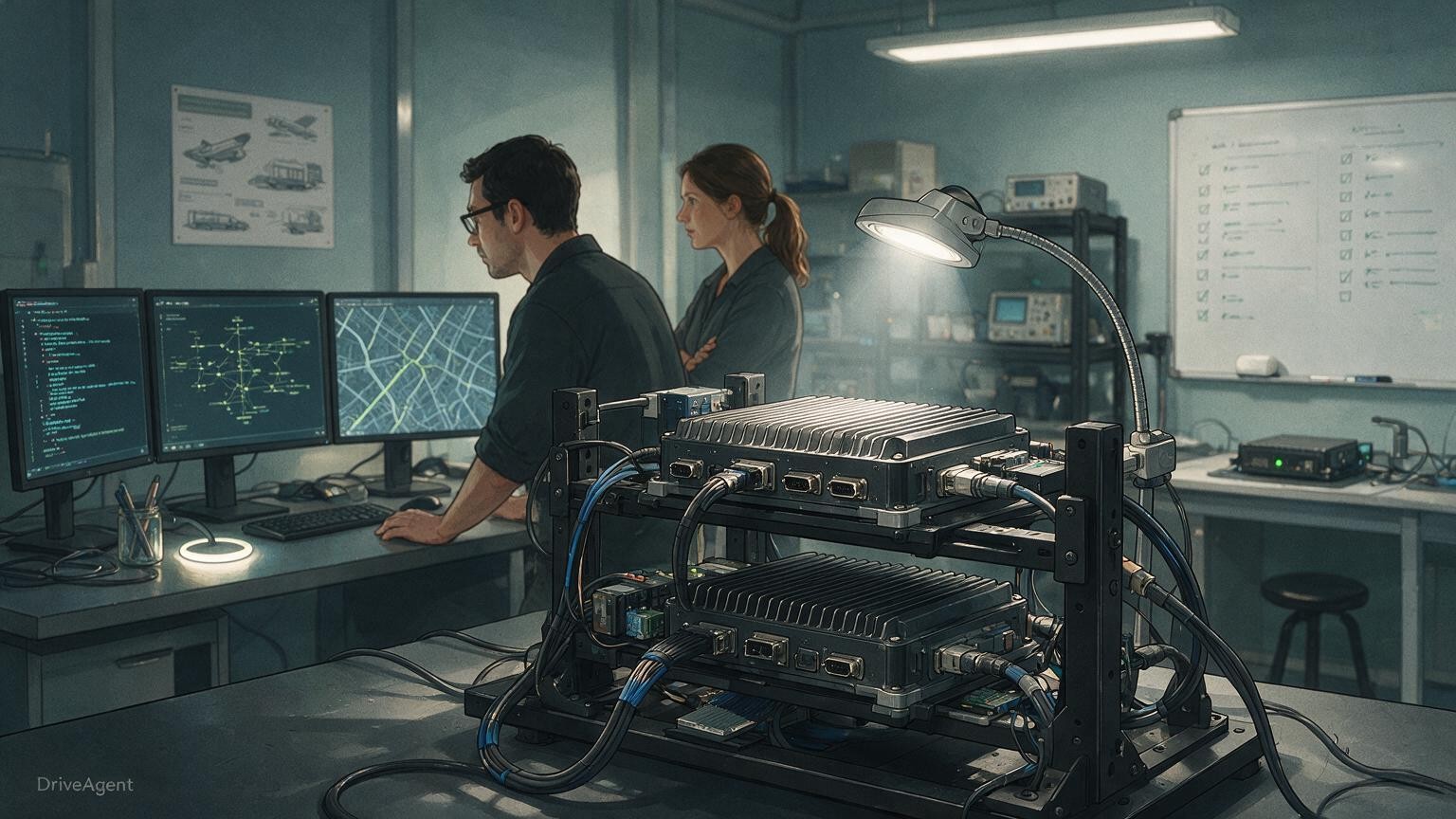
Tier IV, the Japanese company behind the open-source Autoware autonomous driving software, and the Technical University of Munich (TUM) have announced an expanded collaboration centred on Nvidia's Hyperion platform and the Nvidia Halos safety system, with the stated aim of scaling safe, high-performance autonomous driving systems across Germany. The announcement was made at Nvidia's GTC Berlin event and distributed via PR Newswire on October 22, 2026. 32
According to the joint announcement, the projects will use dual Nvidia DRIVE AGX Thor configurations as the compute hardware, combined with the Halos safety system, running Autoware as the driving software. Nvidia describes Hyperion as a reference sensor and compute platform for Level 4 autonomous vehicles and robotaxis, combining automotive-grade compute and safety technologies intended to accelerate safe, production-ready autonomy. The stated focus of the German work is translating advanced research into safe, scalable real-world deployments, including autonomous public transportation and robotaxi applications. 31
Automotive World's report emphasised that the announcement describes planned project work rather than a deployed vehicle or demonstrated performance gain. No timetable for on-road operations under the new initiative was given in the release. 13
Built on the TUM Autoware Research Center
The new initiative builds on the TUM Autoware Research Center by Tier IV, a multi-year strategic research cooperation the two organisations announced on October 15, 2026. According to the TUM announcement, the centre involves three TUM research groups — the Chair of Vehicle Technology (FTM), the Professorship for Cyber-Physical Systems (CPS) and the Professorship for Autonomous Vehicle Systems (AVS) — and is funded through strategic research support from Tier IV. It is intended to serve as a long-term base for autonomous driving research, open-source software development and doctoral training, and to connect academic, industry and public transport projects. 42
The TUM announcement set out three research focus areas for the centre: safety, through a hybrid architecture combining deep-learning-based driving models with rule-based monitoring and a verifiable safety guard that can intervene based on defined safety requirements; evaluation, through a benchmarking and verification framework spanning simulation, offline analysis and real operation, building on TUM's EDGAR research platform and its CommonRoad expertise; and scalability, through a repeatable process for adapting and evaluating Autoware in new environments, with improvements fed back into open-source projects. 4
TUM's prior on-road groundwork includes EDGAR, its autonomous research vehicle running Autoware, which offered public demonstration rides from the Munich trade fair grounds into the city centre at IAA MOBILITY 2025 across urban, rural and autobahn environments. TUM also stated that its team commissioned EDGAR on Berlin's roads within a week, demonstrating autonomous operation in collaboration with the TÜV association, testing a new evaluation methodology for Level 4 autonomous driving in real traffic on behalf of the German federal government. 4
Executives frame the open-source case
Shinpei Kato, founder and chief executive of Tier IV, said in the joint release that scaling safe autonomous driving globally requires moving beyond closed, black box systems toward open, interoperable architectures, and described Nvidia Hyperion as providing the foundation needed to accelerate scalable, publicly trusted autonomous transit in Germany and beyond. 3
TUM's Professor Markus Lienkamp said in the release that leveraging hardware such as Nvidia Hyperion alongside open-source platforms like Autoware is essential to transition autonomous mobility from academic research to trusted real-world deployment, and that the partnership would allow rigorous testing of autonomous vehicle systems on German roads for public transit solutions built on transparent, verifiably safe and collaborative technology. His TUM colleague Professor Johannes Betz said integrating advanced platforms like Hyperion builds on years of joint work on Autoware between TUM and Tier IV, pushing real-time vehicle control and software architecture to a new level. 3
Nvidia's vice president of automotive, Rishi Dhall, said in the release that Hyperion provides the reference sensor and compute architecture needed to develop Level 4 autonomous vehicles and robotaxis at scale, combining DRIVE AGX Thor and the Halos safety system with an open-source autonomous driving platform to accelerate safe, production-ready autonomy. These statements are executive claims within the announcement; no independent verification of performance outcomes accompanies them. 3
Where Hyperion sits in the wider robotaxi push
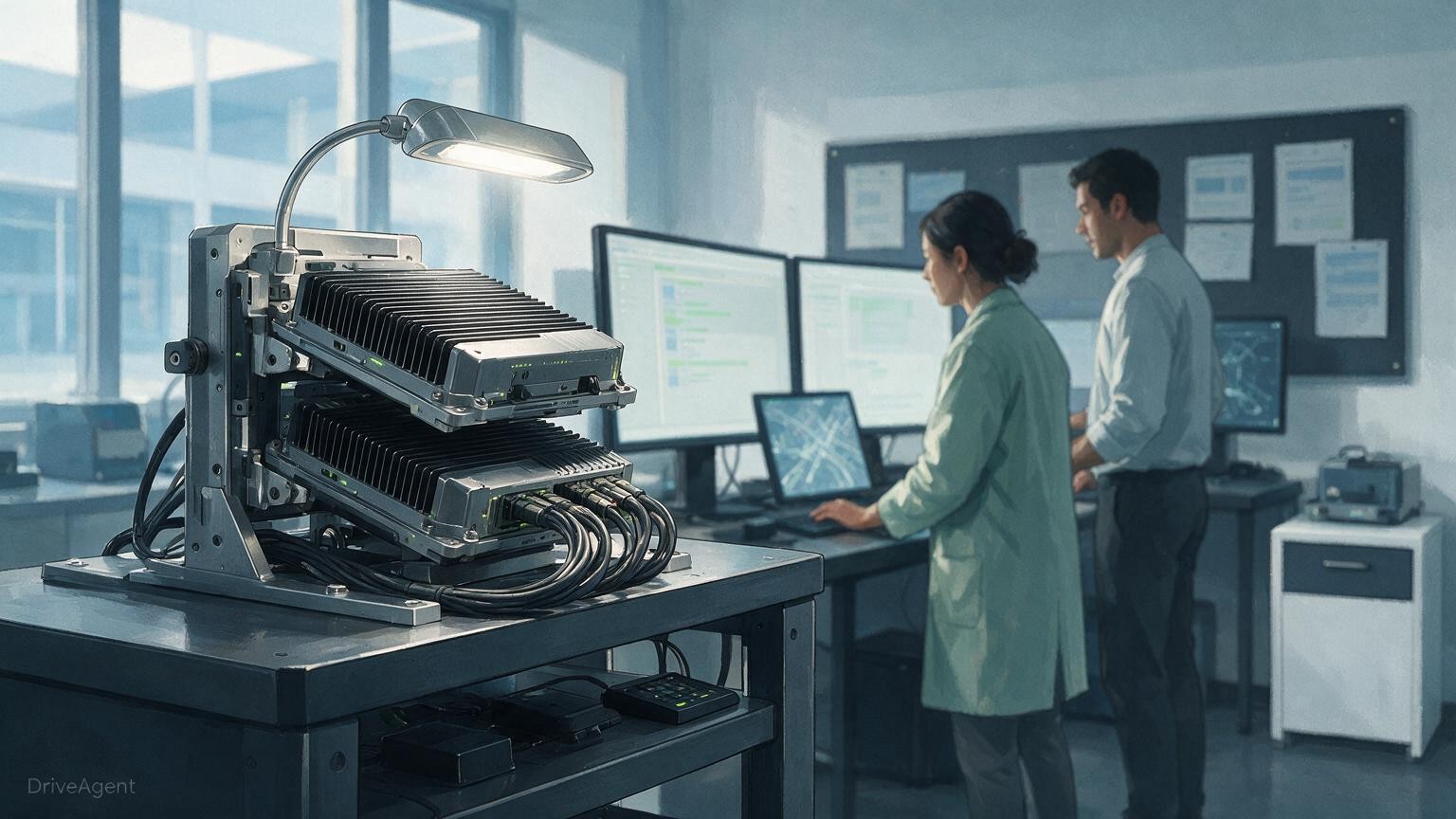
Automotive World reported that the Tier IV–TUM collaboration is the third autonomous driving announcement built on Hyperion at GTC Berlin, following Bolt and Volkswagen Group. Bolt is using Nvidia's own Alpamayo software for its autonomous vehicles across Europe, whereas Tier IV and TUM are pairing the same underlying hardware with open-source code. The publication's analysis was that Nvidia sits beneath open, closed and OEM-led efforts alike, so it benefits whichever software approach prevails as long as it runs on Hyperion. 1
Nvidia's own position, set out in its May 2026 GTC Taipei announcement, is that Hyperion combines high-performance DRIVE AGX in-vehicle compute, the Halos OS built on the safety-certified DriveOS operating system, a compatible multimodal sensor suite and Nvidia DRIVE AV software for level 4-ready vehicles. That ecosystem announcement covered collaborations including Foxconn's planned robotaxi service in Taiwan from 2028, VinFast with Autobrains for Southeast Asia, Uber and Autobrains working toward a robotaxi program in Munich, and HUMAIN for Saudi Arabia. Nvidia renamed DRIVE Hyperion to Nvidia Hyperion in September 2026. 5
The Munich robotaxi program named in Nvidia's ecosystem announcement — Uber with Autobrains on Hyperion, with the selected automaker still to be announced — is a separate effort running proprietary software and should not be conflated with the Tier IV–TUM open-source research programme, which runs on Autoware. 531
Context: Tier IV's Level 4 testing in Munich and broader compute partnerships
The German collaboration sits within a broader Tier IV programme. In March 2026, the company released Autoware-based Level 4 software stacks powered by data-centric AI, configurable either as a hybrid system using perception and planning AI or as an end-to-end system, published on GitHub within the Autoware repositories and described by Tier IV as hardware-agnostic across different system-on-chip and sensor configurations. Validation testing began with university partners in three hubs: Tokyo, Pittsburgh and Munich. 6
In the Munich strand of that testing, Tier IV worked with TUM using a Volkswagen T7 Multivan for safety evaluations across various urban driving scenarios in and around Munich, with test runs of approximately 60 minutes and a safety driver on board in line with local regulations, though no manual intervention was expected under normal operating conditions. Tokyo testing used a Toyota JPN TAXI with the University of Tokyo, and Pittsburgh used a Hyundai IONIQ 5 with Carnegie Mellon University for robotaxi-style urban testing including airport-to-campus routes. 6
Tier IV has also been broadening its compute partnerships beyond Nvidia, including joining Arm's Total Design for Physical AI programme in September 2026 and an August 2026 collaboration with Renesas on an open AI-native computing platform for software-defined vehicles integrating R-Car Gen 5 SoCs with Autoware. Automotive World suggested these moves indicate open AV stacks are hedging across compute suppliers even as Nvidia increasingly underpins open, closed and OEM-led approaches alike. 21
Automotive World also noted that Germany's 2021 legal framework for Level 4 operation in defined areas suits the public transport and shuttle applications TUM is targeting, potentially making Germany an early route from research to commercial deployment for this work. 1
AI evidence finder
Ask about this article
Ask a question to find relevant published passages and source links. AI selects evidence; the passages remain exactly as published.
Behind this report
Sources & context
Cited source mix
6 cited pages across 6 websites
- Role not assessed 6
Website breakdown
- automotiveworld.com1 page
- manilatimes.net1 page
- mos.ed.tum.de1 page
- nvidianews.nvidia.com1 page
- prnewswire.com1 page
- tier4.co.jp1 page
6 cited pages with an undocumented publisher role. Websites may share ownership or repeat the same reporting.
Saved research extracts
6 / 6 cited pages with saved extracts
0 shortened at our text limit · 0 without a saved-extract record
Extracts retrieved 23 Oct 2026.
Extracts can omit page content. These counts do not verify claims or measure independent reporting. Political leaning and reliability are not rated.
- Tier IV and TU Munich plan Nvidia-powered Level 4 vehicle projectsRole not assessedSource extract saved
Why these labels?Tier IV and TU Munich plan Nvidia-powered Level 4 vehicle projects
Who produced it
We have not documented this publisher’s role. An unassigned label is not a negative rating.
How this report uses it
Cited in 6 paragraphs: What was announced at GTC Berlin; Where Hyperion sits in the wider robotaxi push; Context: Tier IV's Level 4 testing in Munich and broader compute partnerships.
This describes its use in our report. It does not establish the source’s editorial stance or independently corroborate every claim.
Evidence record
Text retrieved 23 Oct 2026. The retained extract did not reach our text limit. Extraction can still omit page content.
- Tier IV, Inc. News and Press ReleasesRole not assessedSource extract saved
Why these labels?Tier IV, Inc. News and Press Releases
Who produced it
We have not documented this publisher’s role. An unassigned label is not a negative rating.
How this report uses it
Cited in 3 paragraphs: What was announced at GTC Berlin; Built on the TUM Autoware Research Center; Context: Tier IV's Level 4 testing in Munich and broader compute partnerships.
This describes its use in our report. It does not establish the source’s editorial stance or independently corroborate every claim.
Evidence record
Text retrieved 23 Oct 2026. The retained extract did not reach our text limit. Extraction can still omit page content.
- TIER IV and Technical University of Munich Bring NVIDIA Hyperion to Level 4 Autonomous Driving in GermanyRole not assessedSource extract saved
Why these labels?TIER IV and Technical University of Munich Bring NVIDIA Hyperion to Level 4 Autonomous Driving in Germany
Who produced it
We have not documented this publisher’s role. An unassigned label is not a negative rating.
How this report uses it
Cited in 7 paragraphs: What was announced at GTC Berlin; Executives frame the open-source case; Where Hyperion sits in the wider robotaxi push.
This describes its use in our report. It does not establish the source’s editorial stance or independently corroborate every claim.
Evidence record
Text retrieved 23 Oct 2026. The retained extract did not reach our text limit. Extraction can still omit page content.
- TIER IV und die Technische Universität München gründen das ...Role not assessedSource extract saved
Why these labels?TIER IV und die Technische Universität München gründen das ...
Who produced it
We have not documented this publisher’s role. An unassigned label is not a negative rating.
How this report uses it
Cited in 3 paragraphs: Built on the TUM Autoware Research Center.
This describes its use in our report. It does not establish the source’s editorial stance or independently corroborate every claim.
Evidence record
Text retrieved 23 Oct 2026. The retained extract did not reach our text limit. Extraction can still omit page content.
- NVIDIA Hyperion Becomes the Global Platform for a Robotaxi ...Role not assessedSource extract saved
Why these labels?NVIDIA Hyperion Becomes the Global Platform for a Robotaxi ...
Who produced it
We have not documented this publisher’s role. An unassigned label is not a negative rating.
How this report uses it
Cited in 2 paragraphs: Where Hyperion sits in the wider robotaxi push.
This describes its use in our report. It does not establish the source’s editorial stance or independently corroborate every claim.
Evidence record
Text retrieved 23 Oct 2026. The retained extract did not reach our text limit. Extraction can still omit page content.
- TIER IV unveils AI-based Level 4 autonomous driving ...Role not assessedSource extract saved
Why these labels?TIER IV unveils AI-based Level 4 autonomous driving ...
Who produced it
We have not documented this publisher’s role. An unassigned label is not a negative rating.
How this report uses it
Cited in 2 paragraphs: Context: Tier IV's Level 4 testing in Munich and broader compute partnerships.
This describes its use in our report. It does not establish the source’s editorial stance or independently corroborate every claim.
Evidence record
Text retrieved 23 Oct 2026. The retained extract did not reach our text limit. Extraction can still omit page content.
Keep reading
Related subjects and more from this section.
Mercedes-Benz and NVIDIA extend strategic partnership to develop next-generation automated driving systems
The two companies confirmed on 16 October 2026 that their long-running collaboration will be expanded, pairing Mercedes-Benz engineering and MB.OS with NVIDIA's Hyperion computing, Alpamayo Stack software and Halos safety technology.