Electric Vehicle Council to lead $1.43 million National EV Charging Roadmap due mid-2027
Australia's first national charging roadmap, led by the Electric Vehicle Council with $1.06 million in ARENA funding, will map charging demand, pressure points and investment priorities for passenger cars and electric trucks across metropolitan and regional Australia, with the final document due for release in mid-2027.
Synthesised from the cited sources. Research, writing and factual checks are automated using AI. Verify details against the sources. How we produce these reports
A national roadmap for a rapidly growing charging network
Australia will develop its first national roadmap to help industry and governments plan the charging infrastructure needed to support millions more electric vehicles and a growing fleet of electric trucks expected on local roads by 2035. The $1.43 million National EV Charging Roadmap is led by the Electric Vehicle Council (EVC) and supported by $1.06 million in funding from the Australian Renewable Energy Agency (ARENA) under its Driving the Nation Program, with contributions also coming from the EVC and project partners. The final roadmap is due for release in mid-2027, according to the project's official announcement. 1
The Electric Vehicle Council announced the $1.43 million project on Tuesday to plan charging infrastructure for the years ahead, as reported by AAP and published by PerthNow. According to that report, the roadmap will identify emerging demand for charging infrastructure and potential bottlenecks, drawing on feedback from car makers, electricity networks, charging providers and consumer groups. Stakeholders wishing to contribute are encouraged to sign up for project updates and consultation opportunities through the council's website. 15
The roadmap will bring together car manufacturers, charge point operators, consumer groups, electricity networks and fleet operators to develop an evidence base of future charging needs. It will consider passenger and heavy-vehicle charging together as part of an integrated national system spanning metropolitan and regional Australia, identifying emerging charging demand, pressure points and areas where greater coordination could inform investment decisions, the announcement states. 1
What the project is designed to do — and not do
Electric Vehicle Council chief executive Julie Delvecchio said the debate about whether Australians will choose electric vehicles is increasingly behind the industry, with buyers purchasing EVs in record numbers. "The focus now needs to be on what happens next - so our charging system scales as EV adoption grows," she said in the announcement. She framed the challenge as not simply delivering more chargers, but ensuring investment in the right infrastructure nationally, in the right places and at the right time, which she said requires a more coordinated approach to transport, energy and infrastructure planning. 1
Delvecchio noted that other major EV markets have recognised the value of coordinated national planning, and said the roadmap would bring that to Australia, shaped around the country's distances, its electricity system and the needs of everything from passenger cars to heavy trucks. She added that developing the roadmap would be a starting point rather than the end of the task, with the bigger job being turning evidence into coordinated action across industry, the energy system and government, according to the announcement. 1
Roadmap project director Dr Alina Dini, the EVC's head of energy, infrastructure and commercial, said Australia's charging challenge is not a lack of activity, but that decisions across different sectors are often made independently, without a shared understanding of future demand. The announcement states the roadmap will be a planning and coordination tool rather than a fixed prediction or prescription, with its scenarios and priorities providing a common evidence base as EV uptake, charging technology, consumer behaviour, home charging, network investment and heavy vehicle electrification evolve. AAP's report carried the same characterisation, quoting Dini saying the map could help charging providers identify and coordinate future investment without prescribing where chargers should be installed. 15
ARENA chief executive Darren Miller said a reliable and well-planned charging network will be critical to supporting Australia's transport transition. "While investment in charging infrastructure continues to grow, it's important that future deployment is guided by a clear understanding of where demand will emerge across households, businesses, freight and public charging," he said in the announcement. AAP's report added that Miller said the roadmap would also identify future requirements for heavy vehicles, which he said would play an increasing role in the transport mix. 15
Record fleet growth as the backdrop
The roadmap arrives as Australia's electric vehicle fleet reaches a significant scale. According to the Electric Vehicle Council's State of EVs 2026 report, cited in the AAP report published by PerthNow, the country had more than 600,000 battery-electric vehicles on the road by the end of June, serviced by more than 11,000 public charging points across more than 4200 locations. The report found the number of fast and ultra-fast charging locations grew by 18 per cent over the past year, though growth differed between states. 5
That fleet figure marks a sharp increase from earlier in 2026, when the Electric Vehicle Council put cumulative Australian EV sales at more than 300,000 vehicles, with more than 70,000 sold in the first five months of the year, as reported by Chasing Cars in July. The publication's analysis at that time noted the council's figures, alongside analyst estimates that a fleet of around 300,000 EVs was costing the government roughly $130 million to $165 million a year in forgone fuel excise, based on typical annual driving of 12,000 to 15,000 kilometres. 3
Market momentum continued through 2026. AAP reported that battery-electric models accounted for almost one in every four new cars sold in September as petrol and diesel prices climbed. EV Infrastructure News separately recorded battery-electric market share of 14.6 per cent in March 2026 and 16.4 per cent in April, and reported that EV and plug-in hybrid vehicles combined reached 27.5 per cent of new light vehicle sales in April 2026, up from 1.9 per cent in April 2022, citing climate change minister Chris Bowen's observation that one EV was being purchased every three minutes. 564
Government support beyond the roadmap
The roadmap complements other federal investment in EV infrastructure. In September, Climate Change and Energy Minister Chris Bowen announced a new round of rebates under the government's DRIVEN program, allowing dealers, repairers and mechanics to claim up to $3,000 per EV charging plug and 80 per cent of the cost of EV-specific workshop tools and equipment, up to a total of $50,000 per site. The minister said the expanded support would help small businesses sell, service and repair more EVs across suburban Australia, where EV sales have increased the most. 2
That DRIVEN round remains open for applications until 30 April 2027, with charger rebates subject to a category cap of $21,000, according to the ministerial announcement. It noted August sales figures showing EV sales up 171 per cent year on year, with battery electric vehicles outselling petrol cars for the first time in Australia on 25,824 sales, and battery electric, plug-in hybrid and conventional hybrid vehicles together accounting for more than half of all new vehicle sales. Australian Automotive Dealer Association chief executive James Voortman described the expansion as a practical step, saying dealers across Australia were investing millions in tools, equipment and workshop upgrades required to service electric vehicles. 2
Regulatory settings are also moving in parallel. EV Infrastructure News reported in June that the Australian Energy Market Commission has commenced a review of electricity network economic regulation with EV charging questions at its centre, including whether distribution networks should provide charging infrastructure. Among the first issues is a rule change request from Energy Networks Australia proposing to allow networks to install and operate kerbside EV charging as a regulated service, alongside a Nexa Advisory request to strengthen ring-fencing rules. A final report from the review's second package is expected in the fourth quarter of 2027, after the roadmap's release. 4
The charging network it must plan for
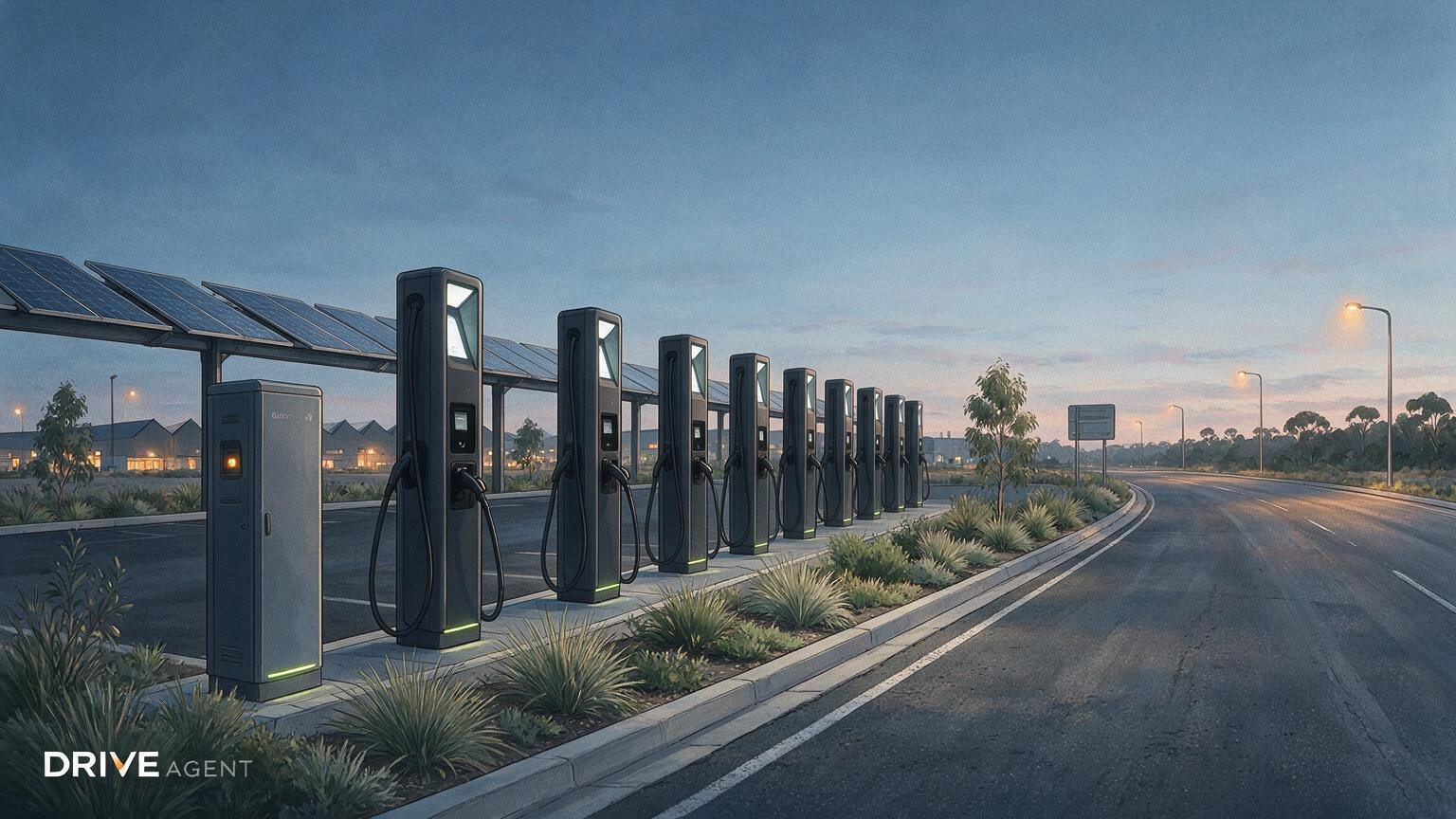
Private rollout of public charging continues alongside the national planning effort. EV Infrastructure News reported in May that EnergyAustralia had begun rolling out ultra-fast EV chargers at 7-Eleven stores across Victoria, NSW and Queensland, with 10 sites planned over two years and the first live at Roxburgh Park in Melbourne's north. Each location features either a 200kW or 400kW ultra-fast charger, and the publication reported that such units can charge a vehicle from 20 to 80 per cent capacity in approximately 12 to 15 minutes, with access via the Chargefox app or tap-and-go payment. 6
EV Infrastructure News reported that the Chargefox network, owned and operated by a consortium of Australian motoring clubs including the NRMA and RACV, currently includes more than 5000 charging bays spanning AC, fast DC and ultra-fast charging options. The 7-Eleven partnership reflects the kind of independently made investment decisions across sectors that the EVC's Dr Dini described as a central challenge for the roadmap to address, with the project intended to bring those decisions under a shared national evidence base. 61
AI evidence finder
Ask about this article
Ask a question to find relevant published passages and source links. AI selects evidence; the passages remain exactly as published.
Behind this report
Sources & context
Cited source mix
6 cited pages across 5 websites
- Role not assessed 6
Website breakdown
- evinfrastructurenews.com2 pages
- chasingcars.com.au1 page
- minister.dcceew.gov.au1 page
- newshub.medianet.com.au1 page
- perthnow.com.au1 page
6 cited pages with an undocumented publisher role. Websites may share ownership or repeat the same reporting.
Saved research extracts
6 / 6 cited pages with saved extracts
0 shortened at our text limit · 0 without a saved-extract record
Extracts retrieved 13 Oct 2026.
Extracts can omit page content. These counts do not verify claims or measure independent reporting. Political leaning and reliability are not rated.
- Electric Vehicle Council to lead ARENA-backed National EV Charging RoadmapRole not assessedSource extract saved
Why these labels?Electric Vehicle Council to lead ARENA-backed National EV Charging Roadmap
Who produced it
We have not documented this publisher’s role. An unassigned label is not a negative rating.
How this report uses it
Cited in 8 paragraphs: A national roadmap for a rapidly growing charging network; What the project is designed to do — and not do; The charging network it must plan for.
This describes its use in our report. It does not establish the source’s editorial stance or independently corroborate every claim.
Evidence record
Text retrieved 13 Oct 2026. The retained extract did not reach our text limit. Extraction can still omit page content.
- More EV chargers set for our suburbsRole not assessedSource extract saved
Why these labels?More EV chargers set for our suburbs
Who produced it
We have not documented this publisher’s role. An unassigned label is not a negative rating.
How this report uses it
Cited in 2 paragraphs: Government support beyond the roadmap.
This describes its use in our report. It does not establish the source’s editorial stance or independently corroborate every claim.
Evidence record
Text retrieved 13 Oct 2026. The retained extract did not reach our text limit. Extraction can still omit page content.
- ANALYSIS: Shortsighted or about time? Aussie EV drivers set ...Role not assessedSource extract saved
Why these labels?ANALYSIS: Shortsighted or about time? Aussie EV drivers set ...
Who produced it
We have not documented this publisher’s role. An unassigned label is not a negative rating.
How this report uses it
Cited in 1 paragraph: Record fleet growth as the backdrop.
This describes its use in our report. It does not establish the source’s editorial stance or independently corroborate every claim.
Evidence record
Text retrieved 13 Oct 2026. The retained extract did not reach our text limit. Extraction can still omit page content.
- AEMC launches electricity network regulation review with ...Role not assessedSource extract saved
Why these labels?AEMC launches electricity network regulation review with ...
Who produced it
We have not documented this publisher’s role. An unassigned label is not a negative rating.
How this report uses it
Cited in 2 paragraphs: Record fleet growth as the backdrop; Government support beyond the roadmap.
This describes its use in our report. It does not establish the source’s editorial stance or independently corroborate every claim.
Evidence record
Text retrieved 13 Oct 2026. The retained extract did not reach our text limit. Extraction can still omit page content.
- National plan to put electric vehicle charging on a mapRole not assessedSource extract saved
Why these labels?National plan to put electric vehicle charging on a map
Who produced it
We have not documented this publisher’s role. An unassigned label is not a negative rating.
How this report uses it
Cited in 5 paragraphs: A national roadmap for a rapidly growing charging network; What the project is designed to do — and not do; Record fleet growth as the backdrop.
This describes its use in our report. It does not establish the source’s editorial stance or independently corroborate every claim.
Evidence record
Text retrieved 13 Oct 2026. The retained extract did not reach our text limit. Extraction can still omit page content.
- EnergyAustralia rolls out 400kW EV chargers at 7-Eleven storesRole not assessedSource extract saved
Why these labels?EnergyAustralia rolls out 400kW EV chargers at 7-Eleven stores
Who produced it
We have not documented this publisher’s role. An unassigned label is not a negative rating.
How this report uses it
Cited in 3 paragraphs: Record fleet growth as the backdrop; The charging network it must plan for.
This describes its use in our report. It does not establish the source’s editorial stance or independently corroborate every claim.
Evidence record
Text retrieved 13 Oct 2026. The retained extract did not reach our text limit. Extraction can still omit page content.
Keep reading
Related subjects and more from this section.
Toyota C-HR electric confirmed for Australia, due mid-2027 with 74.7kWh battery and 165kW motor
Toyota Australia has locked in a battery-electric version of the C-HR small SUV as the brand's second and likely cheapest EV, with confirmed hardware details emerging but pricing and equipment still to be announced ahead of a mid-2027 local arrival.