PAPERCRANES
The ancient art of origami is associated with gifts, entertainment and even maths in education. The paper crane, however, is believed to have miraculous powers…
Manufacturer announcement. This is the manufacturer’s announcement. It is separate from DriveAgent’s original reporting. How we source stories

The ancient art of origami is associated with gifts, entertainment and even maths in education. The paper crane, however, is believed to have miraculous powers…
Words Alyssa Hirose
In Japan, the crane is a symbol of both longevity and fortune. Perhaps that’s why it’s one of the most popular origami creations. It’s also believed that the power of the paper crane goes beyond the simple aesthetic magic of transforming a flat square into the world’s most iconic origami bird. According to one Senbazuru legend, whoever folds one thousand paper cranes will be granted a wish.
Throughout Japan, the story of 12-year-old Sadako Sasaki perhaps best epitomises the Senbazuru legend. Having suffered radiation poisoning from the 1945 Hiroshima atomic bomb, Sadako set out to fold one thousand cranes, hoping to be granted her wish to recover. Her story resonated with the nation and paper cranes continue to be a symbol for recovery, messages of peace and hope across Japan. There’s even a building named ‘paper crane’ in Hiroshima.
Hiroshima’s Children’s Peace Monument was unveiled on May 5, 1958 and commemorates Sadako Sasaki and the thousands of child victims of the atomic bombing of Hiroshima.
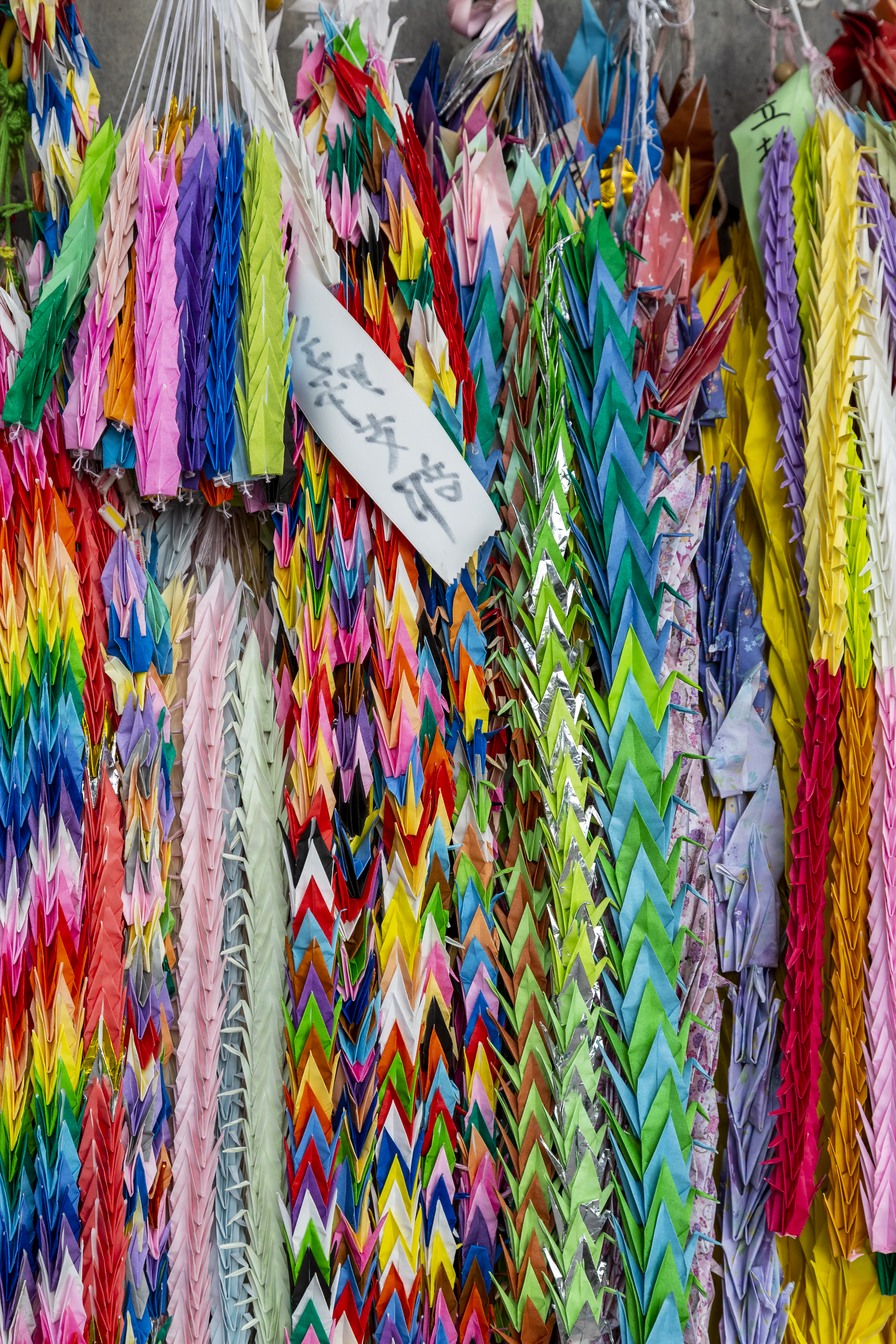
Donated Senbazuru paper cranes from all over the world can be found hanging outside the Children’s Peace Monument in Hiroshima, Japan.
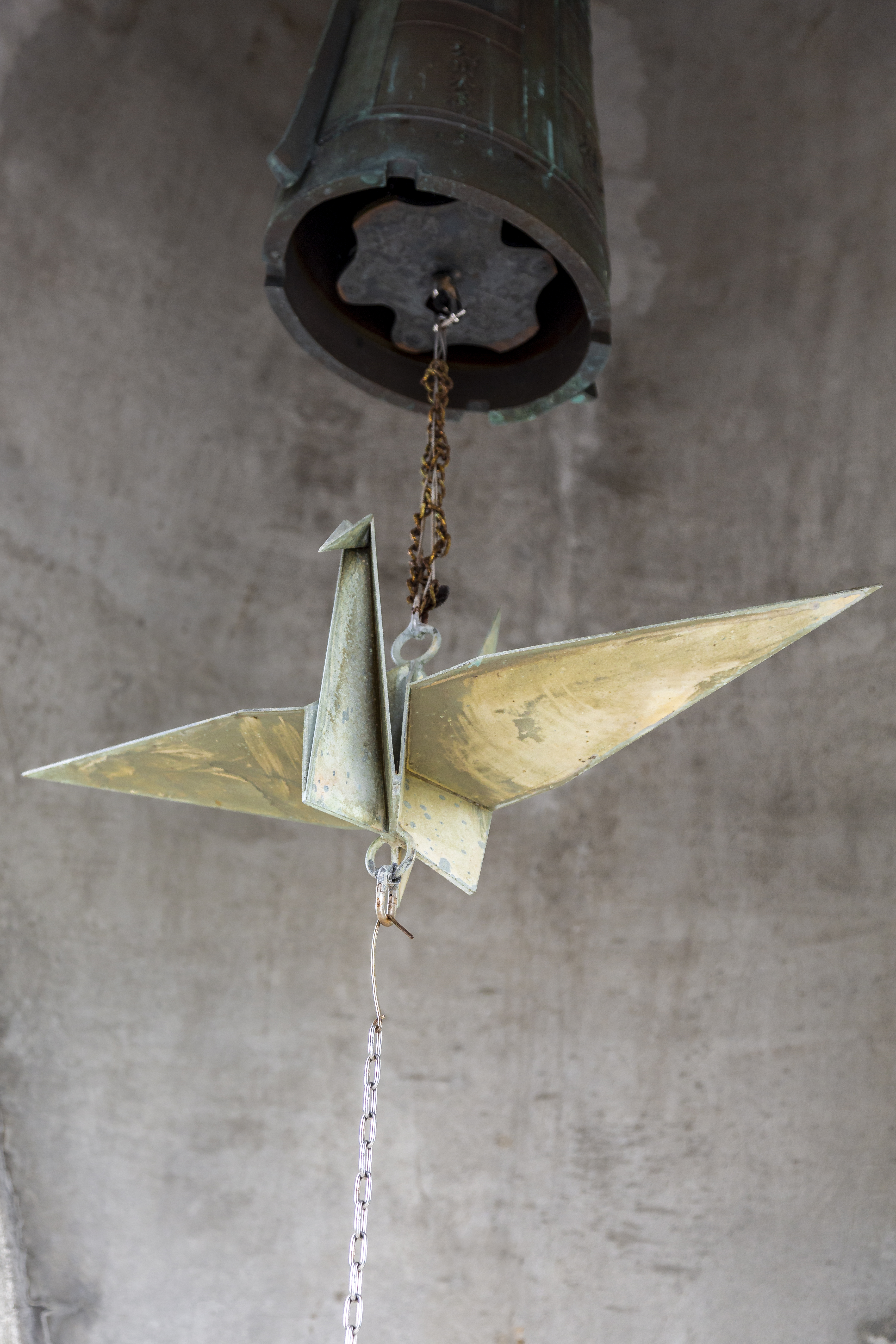
The bronze paper crane at the memorial, itself one of the most popular and most recognised forms of origami, was donated by Nobel Prize winner Hideki Yukawa.
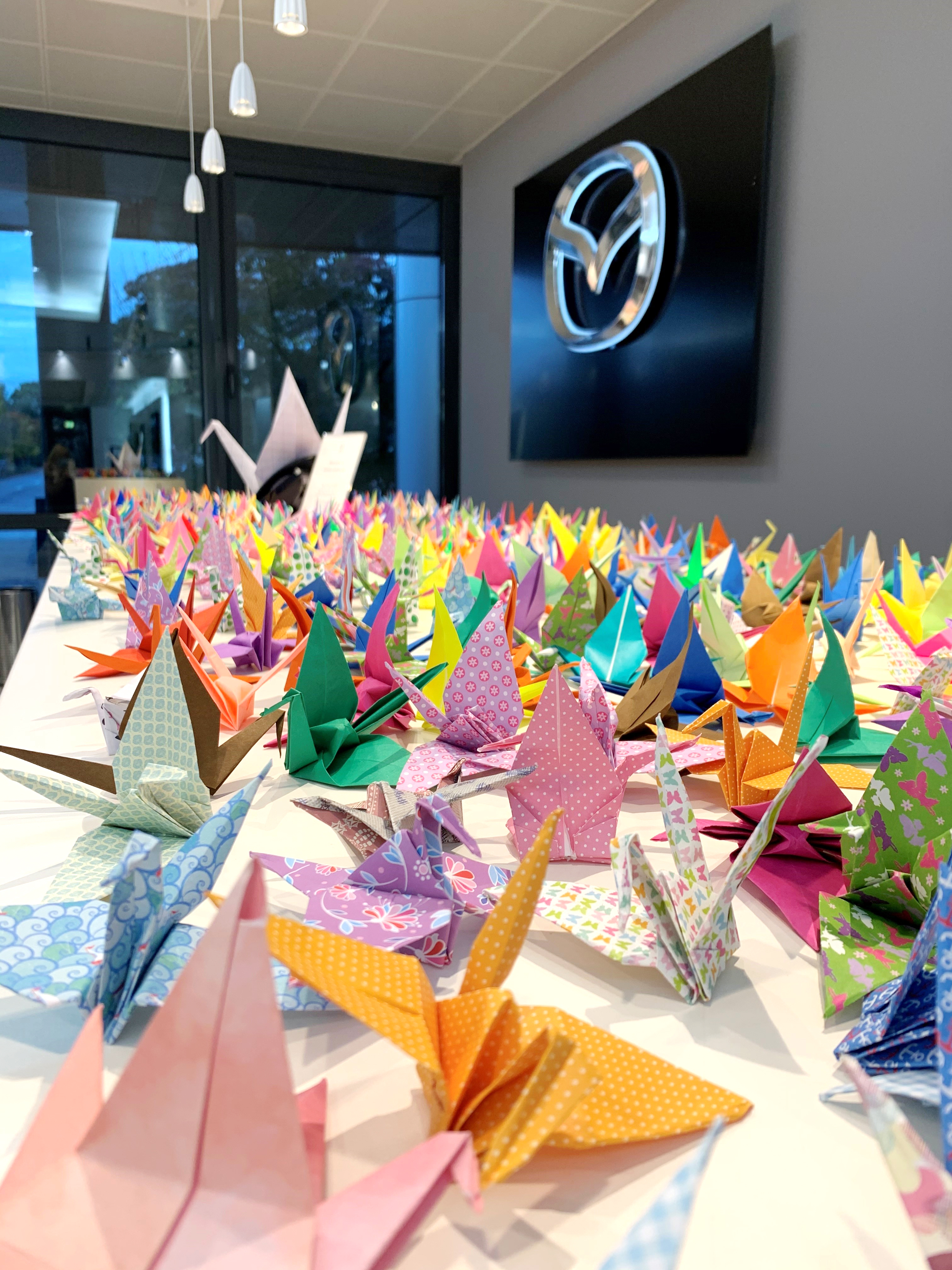
Due to pandemic travel restrictions, visitor numbers to to the peace memorial have declined. With its paper cranes project, Mazda has called upon distributors, employees and communities to donate paper cranes, with thousands received from around the world.
Florida-based artist and teacher Kuniko Yamamoto has always been surrounded by the art of paper folding. “I grew up with origami everywhere in my house—my mother made origami boxes to hold clips, my grandma wrapped eggs neatly in origami, and my uncle did bar tricks with paper napkin origami,” she says.
Yamamoto grew up in Japan. She’s been practising paper folding professionally for two decades, but her roots in origami run much deeper—she first learned the art at the age of five. And, while crafting egg cups or tiny, tidy boxes out of paper are perhaps not a common sight around the world, paper cranes are recognised globally.
“My mother made origami boxes to hold clips, my grandma wrapped eggs neatly in origami, and my uncle did bar tricks with paper napkin origami.”
Kuniko Yamamoto
According to Toshi Aoyagi, a founding member of the Origami Society of Toronto, origami amateurs are always eager to master the ubiquitous crane—but it’s not quite suited for fresh folders. “I consider the crane a graduation piece, for the end of a beginner’s class,” explains Aoyagi. He’s taught origami to adults and children alike for many years, and points out how intimate a craft it is—learning the ins and outs of paper folding requires close, often hands-on instruction that’s individually tailored to the student. “Some say that Japanese people are just naturally good at folding, and I don’t think that’s true,” he says with a laugh.
Typically, origami is thought of as a very old art form, but both Yamamoto and Aoyagi point out that its origins are unknown. The Hiden Senbazuru Orikata (Secret to Folding One Thousand Cranes) is the first known book on origami and was published in 1797. “If that’s the oldest origami book, origami is not that ancient,” points out Aoyagi. Factors like the availability of paper and recreational time are important elements to consider when thinking about origami’s history: art takes resources and hours. Plus, of course, inspiration.
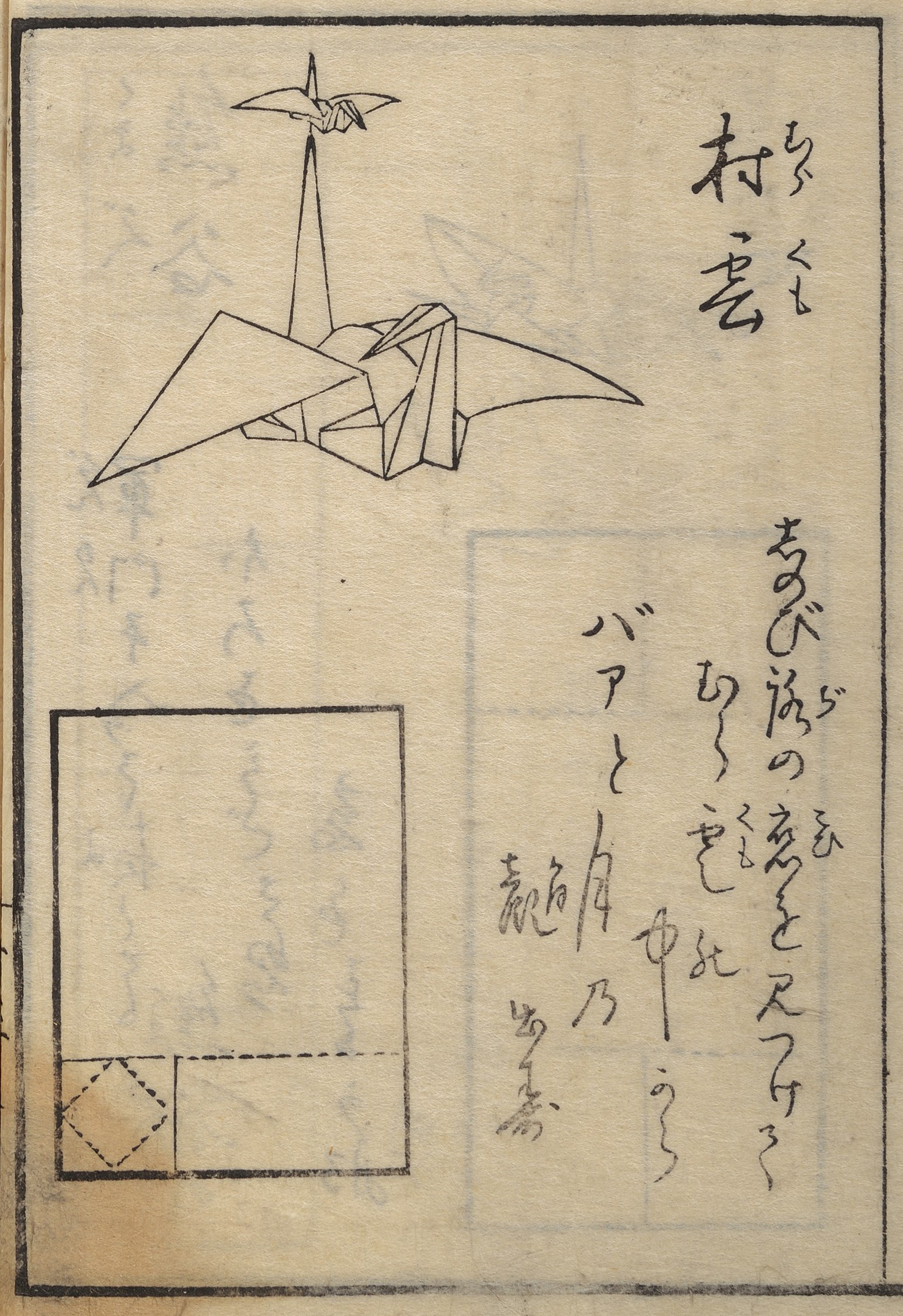
Published in 1797, Hiden Senbazuru Orikata was the first book on origami art.
Wikimedia Commons
Aoyagi considers the paper crane one of the most perfectly crafted objects. That’s because the centre of the crane—the “x” mark on the bird’s back—is the centre of the piece of paper. This becomes obvious when you unfold a crane: the crease pattern extends out from the middle, almost like a snowflake. “It’s such a powerful thing to have this kind of balance in design,” he says. “The amount of paper consumed here, in four different directions, is totally equal.” It’s this balance that allows the crane to be properly hung using just a single thread through its middle.
In fact, the basic-looking crane is a technical marvel, which also makes it an effective teaching tool. Yamamoto says that through origami, “students learn maths, fractions, basic geometry and the number system.” She adds that the craft can foster language arts skills, too, as children learn how to properly communicate each step. “I’m still searching for better ways to connect origami with the school curriculum for creative learning—it’s been a great journey,” she shares. The Children’s Peace Monument in Hiroshima remains covered with bright paper cranes to this day, and cranes are still folded to encourage recovery from sickness (plus as fan gifts for celebrities and athletes, Aoyagi notes), so the magic continues.
Find out more
Mazda and paper cranes
Explore the history of the paper crane, Hiroshima’s unique symbol of peace
More Articles

17/08/2026
Mazda LifeMazda MX-5 GT RS: Tasmania West Coast Road TripRead more
14/08/2026
Mazda LifeMazda Tech Drive: What Is a Mild Hybrid (MHEV)?Read more
07/08/2026
Mazda LifeMazda CX-5 Tech Drive: Evolution of Kodo DesignRead more
31/07/2026
Mazda LifeMazda CX-5 Tech Drive: Inside the CabinRead more
24/07/2026
Mazda LifeMazda CX-5 Tech Drive: Space and PracticalityRead more
23/07/2026
NewsMazda Large SUV Range: 2026 Pricing and Equipment Updates Read more
15/07/2026
Mazda Life7's Day 2026: Celebrating the Mazda RX-7Read more
13/07/2026
NewsAll-Electric Mazda 6e: Australia's Media VerdictRead more
09/07/2026
NewsMazda Assured: Guaranteed Future Value for EVsRead more
03/07/2026
NewsNext-Gen Mazda CX-5 Receives 5-Star ANCAP Safety RatingRead more
03/07/2026
Mazda LifeWork and Play: 20 Years of the Mazda BT-50Read more
01/07/2026
Mazda LifeMazda CX-90 Goes Round the TwistRead moreMore Mazda announcements
View all →
Mazda · Manufacturer news
2026 Mazda MX-5 Update | Mazda Australia
The 2026 Mazda MX-5 arrives with new Zinc Green Metallic paint, standard RECARO seats on the GT RS, and upgraded AEB. Available to order now.

Mazda · Manufacturer news
New Mazda CX-5 Space & Practicality | Tech Drive
How much can the next-generation Mazda CX-5 really carry? Explore the space, comfort and clever practicality behind Australia's favourite SUV.

Mazda · Manufacturer news
Mazda 6e HMI: Shortcuts & Voice Control | Tech Drive
Make the Mazda 6e your own. See how to program the steering wheel shortcut buttons and use 'Hi Mazda' voice control to reach your favourite functions.