Honda and Taisei develop in-road wireless charging, with Japanese expressway tests from fiscal 2027
Honda R&D, Taisei Corporation and Taisei Rotec have developed underlying technology for a magnetic-coupling wireless power transfer road system that charges electric vehicles, including large trucks, while they drive, with public-road demonstrations on the Tateyama Expressway planned from Japan's 2027 fiscal year.
Synthesised from the cited sources. Research, writing and factual checks are automated using AI. Verify details against the sources. How we produce these reports
The announcement and what changed
On October 5, 2026, Honda announced that its research subsidiary Honda R&D Co., Ltd., working with construction contractor Taisei Corporation and road-technology specialist Taisei Rotec Corporation, has developed underlying technology for a magnetic coupling wireless power transfer road system, or WPT road system, capable of charging electric vehicles while they are in motion. The three companies plan demonstration testing on public roads from the Japanese 2027 fiscal year, which starts April 1, 2027, according to Honda's own release. 21
The system combines each partner's proprietary technology: Honda supplies high-power-density power receiver and transmitter units compatible with DC power distribution, Taisei provides a high-response DC power supply system, and Taisei Rotec contributes methods for embedding equipment in road surfaces. Honda says the technology applies to a wide range of mobility products, from passenger EVs to large commercial EVs, though the company states it will initially pursue practical use in the logistics and transportation sectors. 23
Honda has been developing dynamic wireless power transfer (DWPT) technology since 2021, and the three companies have jointly researched the magnetic-coupling WPT road system since 2025. As Honda's own release explains, DWPT is expected to reduce how often EVs need to charge at home or at charging stations by supplying power while vehicles drive. Automotive World's summary of the announcement notes that logistics and large commercial vehicles are first in line. 236
How the system works and why the design matters
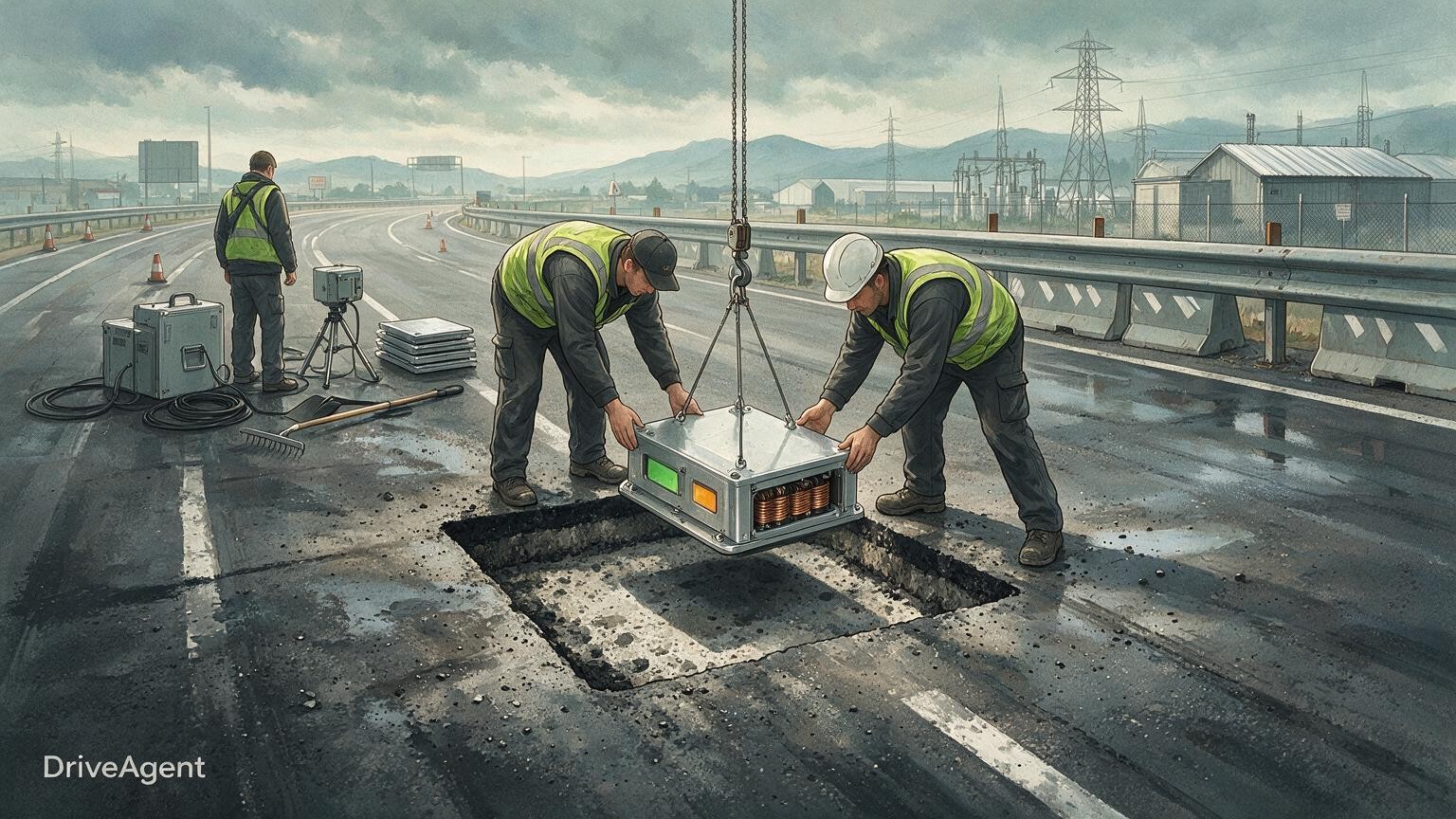
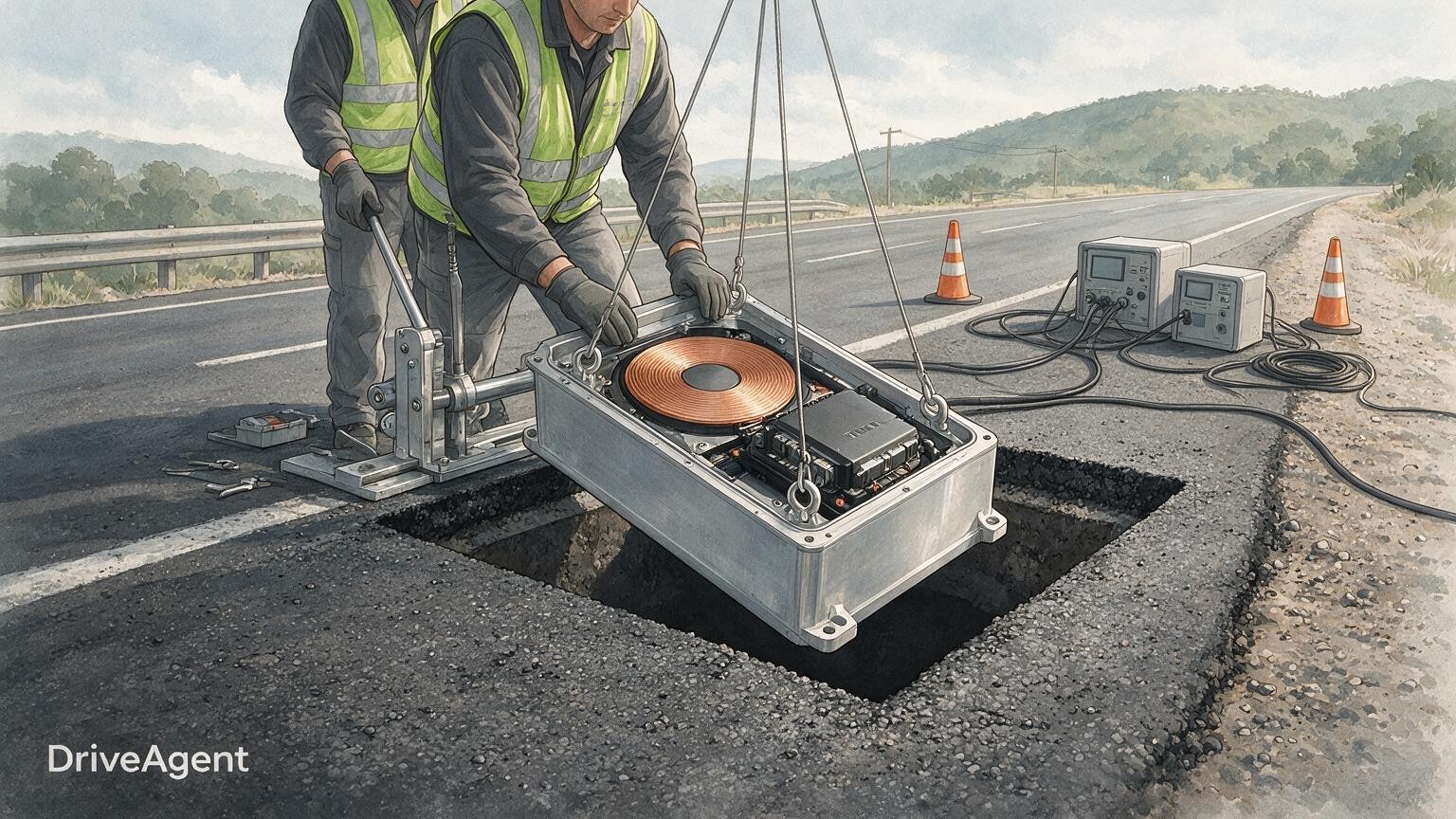
The DWPT system has three key components: a DC power supply system on the ground, a DC distribution-based ground assembly (GA) system linking multiple transmitter units embedded in the road, and a vehicle assembly (VA) receiver unit mounted on the vehicle. Honda R&D develops the GA system and vehicle system, Taisei develops the DC power supply, and Taisei Rotec develops the road construction methods, per Honda's roles table. 216
Honda's headline technical claim is that each embedded GA unit integrates the inverter and coil into a single DWPT unit, described by Honda as the world's first such unit publicly disclosed as of the end of September 2026, based on Honda's own research. According to Honda, this DC distribution structure simplifies wiring in the embedded sections, reducing the number of components and the amount of installation work required. 21
The practical payoff is installation flexibility. The GA units are designed for milling-and-embedding installation into existing pavement, with measures to handle uneven surfaces left by milling, and to be upgraded during future pavement renewal. The Auto Wire's analysis argues this is the real commercial pitch: wiring the road during resurfacing work already scheduled, rather than building a dedicated charging lane from scratch, which shapes Honda's angle of cheaper installation and easier upgrades rather than raw power records. 25
Honda's design also marks a change of approach. The Auto Wire reports that a 2021 Honda presentation outlined a conductive electric road system for heavy trucks using a collector arm reaching to a powered roadside rail at up to 450 kW, paired with a 100 kWh battery and an 80 km/h speed limiter. Moving to magnetic coupling trades peak power for fewer moving parts and no exposed conductors, and could in principle serve passenger cars as well as trucks. 5
Ground-side hardware alone is not the whole picture. Honda's unit and pavement structure has been optimised so embedded transmitters can withstand long-term traffic from large commercial vehicles with loads of approximately 20 tonnes gross vehicle weight, one of three key challenges Honda identified for real-world implementation. 21
Testing programme: durability, performance and leakage
The partners validated the technology on a test roadway at the Future Technology Field for Taisei Group/Satte (T-FIELD/SATTE), where they verified the effectiveness of the WPT system, pavement structures and construction methods intended for public-road testing with large commercial vehicles, according to Honda. 21
From late 2026, a new test drive roadway will be constructed at Taisei's Future Technology Field for Taisei Group/Tamura (T-FIELD/TAMRA). Testing there will include long-term durability evaluation equivalent to 1 million wheel loads at 49 kN per wheel using actual vehicles, DWPT performance tests, and tests of measures addressing electromagnetic field leakage. Honda says these tests aim to ensure both power transfer performance and the safety of the GA units as structures embedded in the roadway. 216
Only after that durability phase do the companies plan to verify performance at high power output levels of up to 150 kW for potential application to large commercial vehicles, and the reliability of power transfer for vehicles travelling at high speeds. The Auto Wire's report of the announcement emphasises that 150 kW is a stated goal to be verified, not a demonstrated result, a distinction worth preserving when weighing the headline figure. 25
Economics remain open. Ground News reports that a Honda engineer declined to comment on cost, noting that economic viability requires assessment, an acknowledgement that the technical demonstration does not yet establish a commercial case. 4
The Tateyama Project and the competitive context
The three companies will participate in the Tateyama Project, a DWPT demonstration to be conducted by road operator East Nippon Expressway Company Limited (NEXCO East) on the Tateyama Expressway in Chiba, Japan, from the Japanese 2027 fiscal year onward, Honda says. The Auto Wire, citing NEXCO East's May 2026 release, describes a roughly 300-metre section of the E14 Tateyama Expressway main line near Kimitsu Parking Area, which NEXCO East calls Japan's first in-motion wireless charging trial on an expressway main line, with multiple runs scheduled from fiscal 2027 and technical support from the University of Tokyo's Fujimoto-Shimizu lab. 25
The same 300-metre stretch will host two teams: Honda with Taisei, and Toyota with Denso and Obayashi, according to The Auto Wire, making the trial effectively a head-to-head comparison of in-road charging approaches on the same pavement under the road operator's oversight. 5
Honda is not the first to demonstrate in-motion charging on comparable power levels. The Auto Wire notes that the Indiana Department of Transportation says a Purdue-designed segment delivered 190 kilowatts to a Cummins truck travelling at 65 mph, and that Electreon says a 1.5-kilometre stretch of France's A10 near Paris charges moving trucks, buses, vans and cars. EV Infrastructure News adds that US-based WiTricity opened an R&D facility in Florida for wireless EV charging a month before Honda's announcement. These overseas projects involve different test conditions and should not be treated as like-for-like results. 56
The Auto Wire also offers a cautionary calculation on what a short trial strip achieves: at 80 km/h a truck crosses 300 metres in about 13.5 seconds, which at a full 150 kW would be roughly 0.56 kWh, a small amount of energy. This is the publication's own analysis, not a Honda claim, and it underscores that meaningful range contribution would require many kilometres of equipped roadway. 5
What is unresolved, and no Australian plans announced
Several questions remain open. NEXCO East says the coils only energise when they detect an equipped vehicle passing overhead, so ordinary traffic receives no power, according to The Auto Wire. That publication also reports that repair and liability questions, such as who pays when a crash damages a buried unit, are unresolved, with no published claims framework despite the modular, upgradeable design. The electromagnetic leakage tests are also significant for regulators ahead of any wider deployment. 5
Honda plans to showcase the DWPT research at the Japan Mobility Show Bizweek, held October 13-16, 2026 at Makuhari Messe in Chiba, and at the ITS World Congress 2026, held October 19-23, 2026 at Gangneung, South Korea, per Honda's announcement. Beyond that, no deployment outside Japan has been announced by the companies, and no Australian rollout plans are established by the announcements covered here. 25
AI evidence finder
Ask about this article
Ask a question to find relevant published passages and source links. AI selects evidence; the passages remain exactly as published.
Behind this report
Sources & context
Cited source mix
6 cited pages across 5 websites
- Role not assessed 6
Website breakdown
- global.honda2 pages
- automotiveworld.com1 page
- evinfrastructurenews.com1 page
- ground.news1 page
- theautowire.com1 page
6 cited pages with an undocumented publisher role. Websites may share ownership or repeat the same reporting.
Saved research extracts
6 / 6 cited pages with saved extracts
0 shortened at our text limit · 0 without a saved-extract record
Extracts retrieved 23 Oct 2026.
Extracts can omit page content. These counts do not verify claims or measure independent reporting. Political leaning and reliability are not rated.
- TopicsRole not assessedSource extract saved
Why these labels?Topics
Who produced it
We have not documented this publisher’s role. An unassigned label is not a negative rating.
How this report uses it
Cited in 6 paragraphs: The announcement and what changed; How the system works and why the design matters; Testing programme: durability, performance and leakage.
This describes its use in our report. It does not establish the source’s editorial stance or independently corroborate every claim.
Evidence record
Text retrieved 23 Oct 2026. The retained extract did not reach our text limit. Extraction can still omit page content.
- Honda Develops Underlaying Technology for In-motion ...Role not assessedSource extract saved
Why these labels?Honda Develops Underlaying Technology for In-motion ...
Who produced it
We have not documented this publisher’s role. An unassigned label is not a negative rating.
How this report uses it
Cited in 12 paragraphs: The announcement and what changed; How the system works and why the design matters; Testing programme: durability, performance and leakage; The Tateyama Project and the competitive context; What is unresolved, and no Australian plans announced.
This describes its use in our report. It does not establish the source’s editorial stance or independently corroborate every claim.
Evidence record
Text retrieved 23 Oct 2026. The retained extract did not reach our text limit. Extraction can still omit page content.
- Honda develops road charging system for EVs on the moveRole not assessedSource extract saved
Why these labels?Honda develops road charging system for EVs on the move
Who produced it
We have not documented this publisher’s role. An unassigned label is not a negative rating.
How this report uses it
Cited in 2 paragraphs: The announcement and what changed.
This describes its use in our report. It does not establish the source’s editorial stance or independently corroborate every claim.
Evidence record
Text retrieved 23 Oct 2026. The retained extract did not reach our text limit. Extraction can still omit page content.
- Honda plans highway test of wireless charging for moving ...Role not assessedSource extract saved
Why these labels?Honda plans highway test of wireless charging for moving ...
Who produced it
We have not documented this publisher’s role. An unassigned label is not a negative rating.
How this report uses it
Cited in 1 paragraph: Testing programme: durability, performance and leakage.
This describes its use in our report. It does not establish the source’s editorial stance or independently corroborate every claim.
Evidence record
Text retrieved 23 Oct 2026. The retained extract did not reach our text limit. Extraction can still omit page content.
- Honda Wants to Charge Your EV Through the Road, and ...Role not assessedSource extract saved
Why these labels?Honda Wants to Charge Your EV Through the Road, and ...
Who produced it
We have not documented this publisher’s role. An unassigned label is not a negative rating.
How this report uses it
Cited in 9 paragraphs: How the system works and why the design matters; Testing programme: durability, performance and leakage; The Tateyama Project and the competitive context; What is unresolved, and no Australian plans announced.
This describes its use in our report. It does not establish the source’s editorial stance or independently corroborate every claim.
Evidence record
Text retrieved 23 Oct 2026. The retained extract did not reach our text limit. Extraction can still omit page content.
- www.evinfrastructurenews.com · ev-technology · hondaHonda develops in-motion wireless EV chargerRole not assessedSource extract saved
Why these labels?www.evinfrastructurenews.com · ev-technology · hondaHonda develops in-motion wireless EV charger
Who produced it
We have not documented this publisher’s role. An unassigned label is not a negative rating.
How this report uses it
Cited in 4 paragraphs: The announcement and what changed; How the system works and why the design matters; Testing programme: durability, performance and leakage; The Tateyama Project and the competitive context.
This describes its use in our report. It does not establish the source’s editorial stance or independently corroborate every claim.
Evidence record
Text retrieved 23 Oct 2026. The retained extract did not reach our text limit. Extraction can still omit page content.
Keep reading
Related subjects and more from this section.
Geely EX2 faces the MG4 Urban: what the road tests and specs reveal about Australia's cheapest EV hatch duel
Australia's second-cheapest electric car has landed against the MG 4 EV Urban, and the verified road-test evidence points to a clear split: the Geely wins on cabin quality, practicality and efficiency, while the MG counters with more space, more performance and longer range.