GM says AI and virtual engineering are halving its vehicle development time to around two years
At its GM Forward event in New York, General Motors laid out a concurrent engineering model it says will cut new-vehicle development from four to five years to roughly two, with virtual battery testing, an AI-assisted Corvette ZR1 top-speed story and a fourth-generation EV platform as evidence. Reporting by CarExpert, CNBC, Autoweek, Car and Driver and The Verge.
Synthesised from the cited sources. Research, writing and factual checks are automated using AI. Verify details against the sources. How we produce these reports
GM's two-year development target
General Motors says artificial intelligence and simulation are allowing it to develop new vehicles in roughly half the time the process has traditionally taken. At the GM Forward event in New York, chief product officer Sterling Anderson described the conventional development process as a relay race, with designers handing sketches to engineers and engineers handing blueprints to manufacturing, and said that sequential process and its iterations on average took the industry four to five years. GM's newsroom release frames the goal as cutting that traditional four-to-five-year timeline in half through enterprise AI and virtualisation, unifying design, engineering and manufacturing from day one on a shared digital thread. 12
Jason Fischer, GM's executive director of virtual integration, said the new concurrent engineering operating system will allow GM to develop vehicles in two years, where conventionally it takes quite a bit longer. CNBC reports GM is targeting roughly a two-year cycle from concept to production but did not detail a timeline for reaching that goal, while Autoweek reports GM suggested two-year-development vehicles might be seen by 2030. Physical testing is expected to be reduced by 50 percent, according to Fischer as reported by Autoweek. 134
The Corvette ZR1 and other worked examples
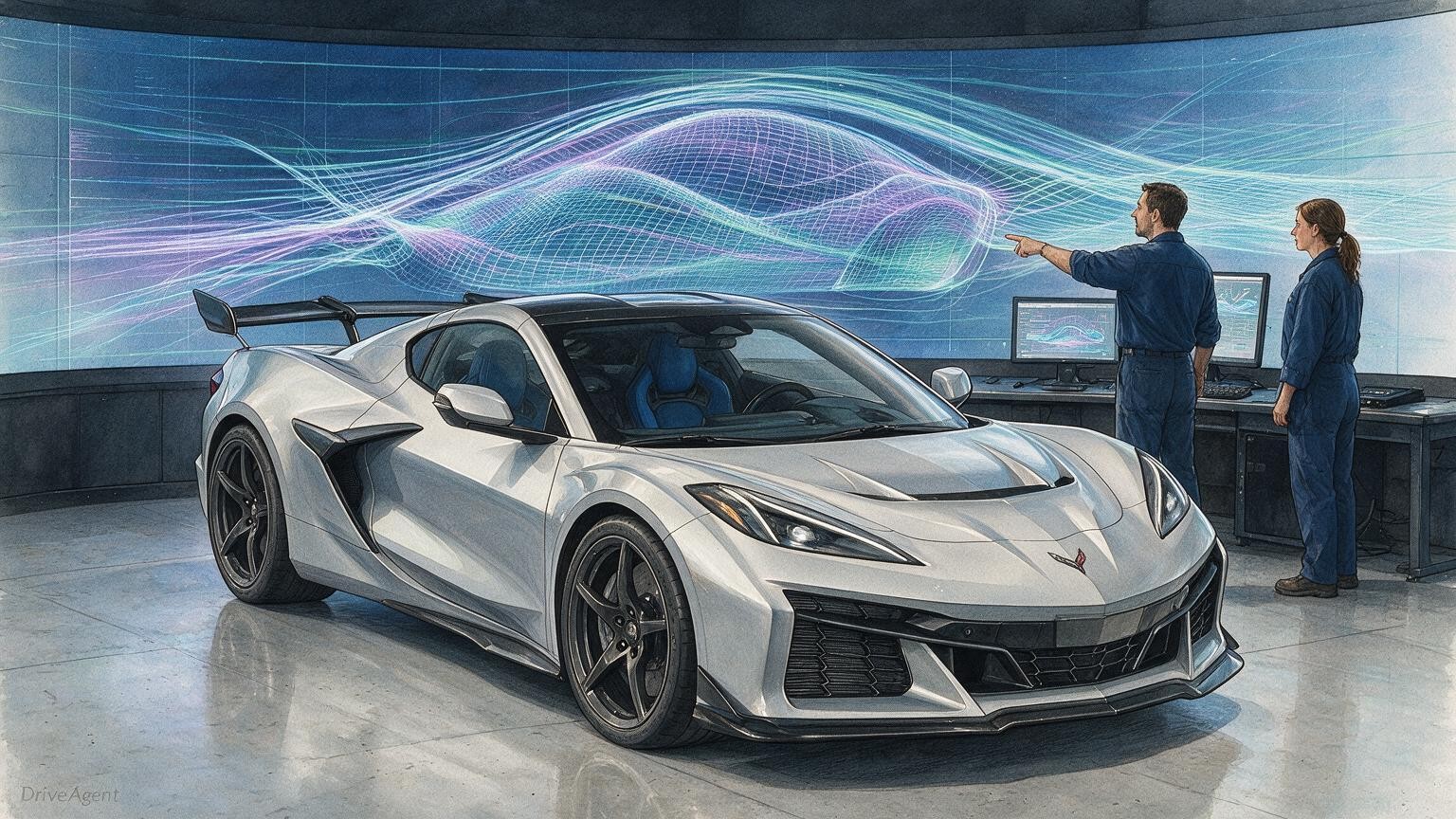
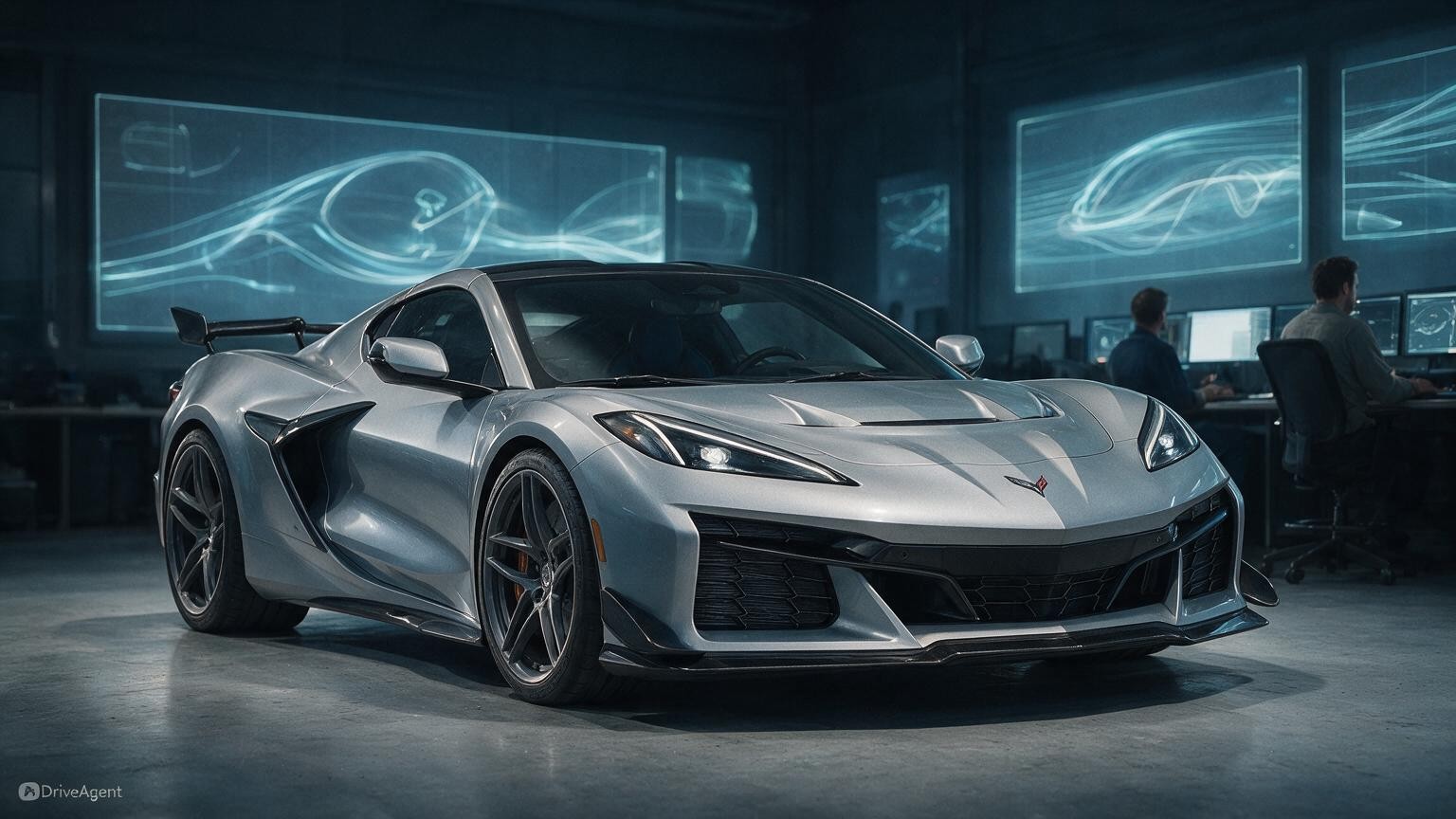
The headline example GM offered concerns aerodynamics. CarExpert reports that computational fluid dynamics simulations can take up to 60 hours to run, in practice limiting GM to one design iteration a day. GM has developed its own machine-learning tool, trained on decades of in-house data, which Anderson said produces results remarkably similar to CFD in about 60 seconds. These are GM's own claims about its proprietary tools, made at its own event. 1
The most vivid demonstration involved the Chevrolet Corvette ZR1. Fischer said the car initially hit 231 mph (372 km/h) in top-speed testing, but GM's virtual model indicated it should be capable of around 233 mph (375 km/h). The team in Pontiac re-spun the powertrain calibration overnight and the next day the car hit 233 mph, which Fischer said shows virtual engineering confirming known results and letting engineers perfect the vehicle at the end rather than discovering issues late. CarExpert notes the ZR1 is produced only in left-hand drive and is not part of the Corvette line-up offered in Australia. 1
Other cited examples include a battery screening campaign for GM's new lithium manganese-rich (LMR) cells that Anderson said would normally require more than 60,000 lab hours but was completed in 256, and the new V8 engines in the 2027 Chevrolet Silverado, which GM says were developed in around a third of the usual time. Fischer said GM can now compress around 100 days of test data into a single day and calibrate powertrain, stability control, ABS and thermal systems in a driver-in-the-loop simulator before a prototype is built. 1
LMR batteries and the Gen 4 EV platform
The development process is already shaping GM's fourth-generation EV platform. GM's release says more than 300,000 battery designs were tested virtually before a single physical prototype was built, enabling the team to move from the first LMR battery pack concept to formal program approval in just one month. According to CNBC, Anderson said at the event that LMR will be the exclusive battery chemistry for the fourth-generation EVs, having previously flagged LMR for full-size electric vehicles such as the Chevrolet Silverado and Escalade IQ beginning in 2028. 23
GM says the LMR cells offer 33 percent higher energy density than the lithium iron phosphate (LFP) cells commonly used in low-cost applications at a comparable cost, and that the whole powertrain was engineered as an integrated system. Autoweek reports GM president Mark Reuss saying full-scale LMR production is under way at the Ultium Cells joint venture with LG Energy Solution in Spring Hill, Tennessee, and that GM has invested US$900 million in battery research. 46
The Gen 4 platform claims include redesigned drive units with 40 percent fewer parts than today, vehicles that are 15 percent lighter and 25 percent more aerodynamic than current EVs, and a 20 percent improvement in range extracted per kilowatt-hour compared with earlier designs. Car and Driver describes the architecture as underpinning what Reuss calls mainstream EVs, with Reuss adding that GM remains committed to EVs for the long term even as it offers customers choice today. Note these are manufacturer figures; gross versus usable battery capacities, cell voltage and range test cycles were not stated in this coverage. 245
One central computer, from Escalade IQ to Silverado
GM's next-generation electrical architecture consolidates perception, propulsion, active safety and chassis controls onto a single liquid-cooled Central Compute Unit, decoupling software from hardware. GM claims it delivers 40 times the computing power of previous systems with 30 percent less wiring length and mass, and up to 50 percent faster cellular connectivity. Following a 2028 debut on the Cadillac Escalade IQ, GM says it will quickly roll the platform out across its highest-volume petrol full-size SUVs and trucks, its three-row crossovers and its fourth-generation EVs. 26
Car and Driver reports the new computer is also expected in the Chevrolet Traverse, Buick Enclave and GMC Acadia and in the full-size SUV and light-duty pickup lines, with no dates given, but that the changeover does not need to wait for a major redesign and can occur as part of a mid-cycle update. GM's director of global EV architecture, Zach Walker, told CarExpert that the centralised computer arriving from 2028 means new features can arrive via over-the-air updates mid-cycle rather than waiting for a new model. 15
Context, competition and caveats
The event comes as Chinese automakers expand rapidly abroad. CNBC reports consulting firm AlixPartners believes China is currently bringing vehicles to market twice as fast as traditional automakers, with 40 to 50 percent less investment and a 30 percent cost advantage. Anderson told CNBC the rapid development approach and new software architecture will help GM compete against Chinese automakers abroad, saying there is inherent virtue to speed, not just in getting a car out faster but in developing a more performant system. 3
GM says it has invested more than US$16 billion (about A$23 billion) in US research and development and manufacturing this year alone, including digital twins of factories, a robotics platform that can test a robot's grip in half a second, and tools that have cut battery pack assembly time by around 30 percent. The Verge reports the factory digital-twin project is dubbed PlantBrAIn, pairing real-time factory floor data with simulations across stamping, casting, welding, painting and assembly. 16
The coverage carries some independent scepticism. Autoweek notes much of the technology shown has been seen elsewhere in other forms, and quotes Juergen Reers of Accenture saying the differentiator will be the ability to combine vehicle data and a digital ecosystem with a unique brand experience, transparency and customer trust. The Verge observes GM has promised smarter cars and faster software updates for years, referencing the 2020 Cadillac CT5 digital architecture and the Ultifi software platform, and argues that for an automaker whose software rollouts have occasionally stumbled, execution remains everything. Autoweek also notes the event display inadvertently showed a Silverado's 14 mpg fuel economy, and that GM is currently short on in-demand hybrids. 46
What this means for Australian buyers
CarExpert reports GM currently sells the Chevrolet Corvette Stingray, E-Ray and Z06 in Australia in factory right-hand drive, along with the locally remanufactured right-hand-drive Chevrolet Silverado 1500, Silverado HD and GMC Yukon Denali, plus a range of right-hand-drive electric Cadillac SUVs. The Corvette ZR1 at the centre of GM's top-speed example is not among them, as it is produced only in left-hand drive. 1
The announcements with the clearest flow-through to Australian-sold product are the faster development cadence itself and the new central compute architecture, which GM says will reach high-volume petrol models such as the Silverado and full-size SUVs alongside its EVs. Any Australian availability or specification for Gen 4 EV models or the new compute platform has not been separately announced in this coverage, so local timing and equipment remain unconfirmed. 125
AI evidence finder
Ask about this article
Ask a question to find relevant published passages and source links. AI selects evidence; the passages remain exactly as published.
Behind this report
Sources & context
Cited source mix
6 cited pages across 6 websites
- News publisher 1
- Role not assessed 5
Website breakdown
- autoweek.com1 page
- caranddriver.com1 page
- CarExpertcarexpert.com.au1 page
- cnbc.com1 page
- news.gm.com1 page
- theverge.com1 page
5 cited pages with an undocumented publisher role. Websites may share ownership or repeat the same reporting.
Saved research extracts
6 / 6 cited pages with saved extracts
0 shortened at our text limit · 0 without a saved-extract record
Extracts retrieved 23 Oct 2026.
Extracts can omit page content. These counts do not verify claims or measure independent reporting. Political leaning and reliability are not rated.
- GM says AI is halving the time it takes to develop a new carNews publisherSource extract saved
Why these labels?GM says AI is halving the time it takes to develop a new car
Who produced it
Publishes automotive news and reviews and operates a car-buying service connecting buyers with dealers. Identity reference ↗
How this report uses it
Cited in 9 paragraphs: GM's two-year development target; The Corvette ZR1 and other worked examples; One central computer, from Escalade IQ to Silverado; Context, competition and caveats; What this means for Australian buyers.
This describes its use in our report. It does not establish the source’s editorial stance or independently corroborate every claim.
Evidence record
Text retrieved 23 Oct 2026. The retained extract did not reach our text limit. Extraction can still omit page content.
- GM Forward: Engineering the intelligence-defined vehicle for everyoneRole not assessedSource extract saved
Why these labels?GM Forward: Engineering the intelligence-defined vehicle for everyone
Who produced it
We have not documented this publisher’s role. An unassigned label is not a negative rating.
How this report uses it
Cited in 5 paragraphs: GM's two-year development target; LMR batteries and the Gen 4 EV platform; One central computer, from Escalade IQ to Silverado; What this means for Australian buyers.
This describes its use in our report. It does not establish the source’s editorial stance or independently corroborate every claim.
Evidence record
Text retrieved 23 Oct 2026. The retained extract did not reach our text limit. Extraction can still omit page content.
- GM aims to develop vehicles in as little as two years with AI ...Role not assessedSource extract saved
Why these labels?GM aims to develop vehicles in as little as two years with AI ...
Who produced it
We have not documented this publisher’s role. An unassigned label is not a negative rating.
How this report uses it
Cited in 3 paragraphs: GM's two-year development target; LMR batteries and the Gen 4 EV platform; Context, competition and caveats.
This describes its use in our report. It does not establish the source’s editorial stance or independently corroborate every claim.
Evidence record
Text retrieved 23 Oct 2026. The retained extract did not reach our text limit. Extraction can still omit page content.
- GM Says AI Could Cut New-Car Development Time in HalfRole not assessedSource extract saved
Why these labels?GM Says AI Could Cut New-Car Development Time in Half
Who produced it
We have not documented this publisher’s role. An unassigned label is not a negative rating.
How this report uses it
Cited in 4 paragraphs: GM's two-year development target; LMR batteries and the Gen 4 EV platform; Context, competition and caveats.
This describes its use in our report. It does not establish the source’s editorial stance or independently corroborate every claim.
Evidence record
Text retrieved 23 Oct 2026. The retained extract did not reach our text limit. Extraction can still omit page content.
- GM Tech Day: Autonomous Driving, More Helpful OnStar, Faster Product DevelopmentRole not assessedSource extract saved
Why these labels?GM Tech Day: Autonomous Driving, More Helpful OnStar, Faster Product Development
Who produced it
We have not documented this publisher’s role. An unassigned label is not a negative rating.
How this report uses it
Cited in 3 paragraphs: LMR batteries and the Gen 4 EV platform; One central computer, from Escalade IQ to Silverado; What this means for Australian buyers.
This describes its use in our report. It does not establish the source’s editorial stance or independently corroborate every claim.
Evidence record
Text retrieved 23 Oct 2026. The retained extract did not reach our text limit. Extraction can still omit page content.
- GM promises smarter cars, faster updates, and ...Role not assessedSource extract saved
Why these labels?GM promises smarter cars, faster updates, and ...
Who produced it
We have not documented this publisher’s role. An unassigned label is not a negative rating.
How this report uses it
Cited in 4 paragraphs: LMR batteries and the Gen 4 EV platform; One central computer, from Escalade IQ to Silverado; Context, competition and caveats.
This describes its use in our report. It does not establish the source’s editorial stance or independently corroborate every claim.
Evidence record
Text retrieved 23 Oct 2026. The retained extract did not reach our text limit. Extraction can still omit page content.
Keep reading
Related subjects and more from this section.

Mercedes-Benz unveils PLM.AI, targeting a 17-month cut in vehicle development time
Mercedes-Benz has announced an AI-native product lifecycle management platform that the company says will shorten new vehicle development by around 17 months, or up to 30 per cent, backed by an investment of roughly half a billion euros.