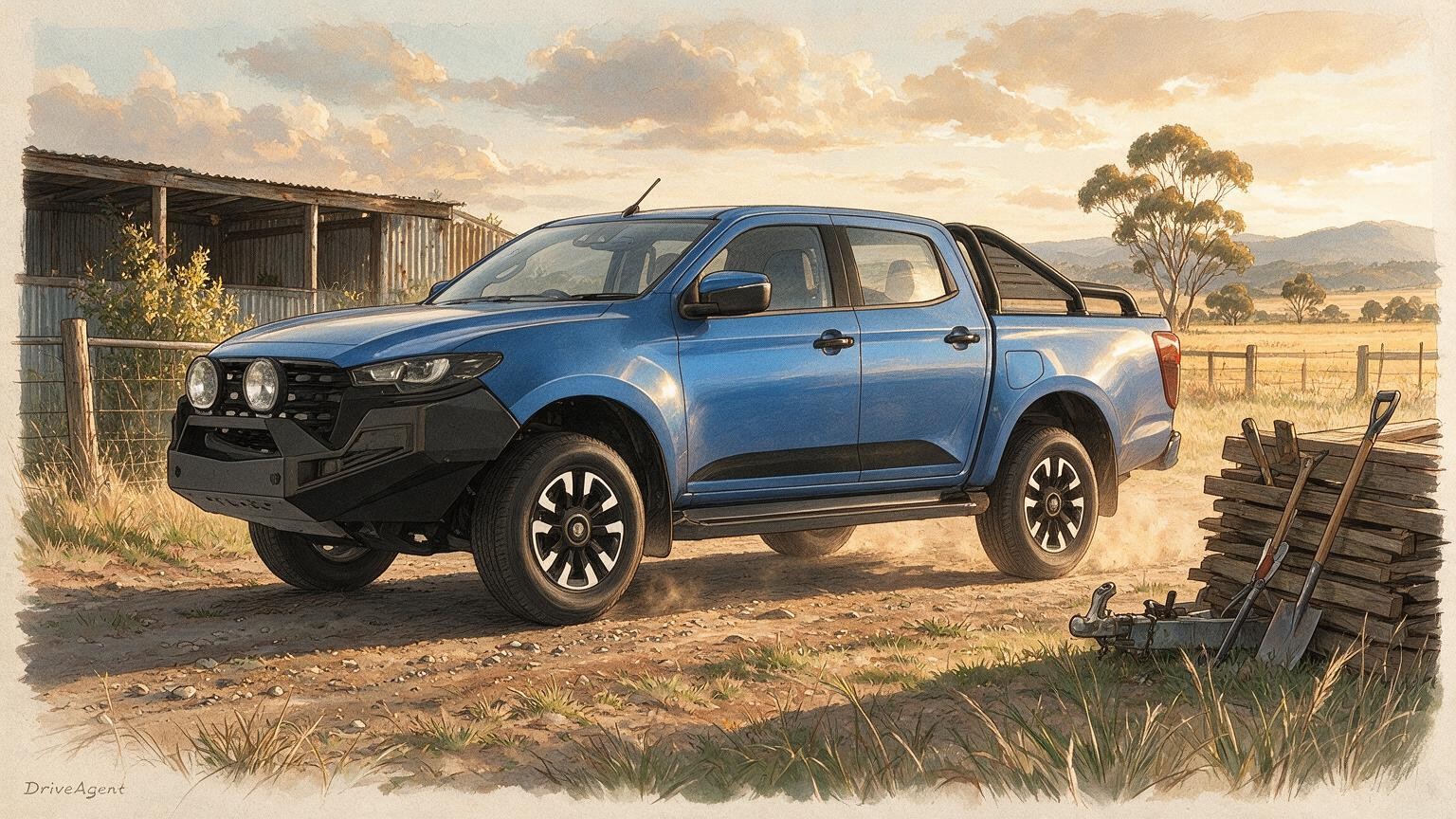
Isuzu Ute Australia rules out battery-electric D-Max, backing diesel for the foreseeable future
GoAuto reports Isuzu Ute Australia has confirmed the current battery-electric D-Max will not join its local line-up, reversing an earlier position that had Australia among the electric ute's intended markets, with the importer instead doubling down on its 2.2- and 3.0-litre diesel engines.
Automatically researched, written and checked using AI. Verify details against the sources.
Electric D-Max ruled out for Australia
Isuzu Ute Australia has walked away from plans to introduce the battery-electric D-Max locally, reversing an earlier position that had Australia among the markets earmarked for the zero-emissions ute when Isuzu Motors outlined the vehicle in 2024. GoAuto reports the importer has now confirmed the current D-Max EV will not form part of its Australian line-up, having previously softened its language last year by saying it would monitor local acceptance of battery-electric vehicles without committing to a launch timetable. 1
In a statement to GoAuto, Isuzu Motors International Operations said: "While Isuzu remains committed to exploring future electrification opportunities, the decision has been made not to export the BEV D-Max to Australia at this time due to the need to prioritise products that align with our current customer needs." IUA executive general manager Rod Caldwell added that while the D-Max BEV is not the right fit for Australian customers in its current form, Isuzu remains committed to exploring future electrification through initiatives such as Earth Lab. 1
GoAuto notes the key distinction is that IUA's decision relates specifically to the current D-Max EV. It does not necessarily rule out a different battery-electric, hybrid, plug-in hybrid or other electrified D-Max in a future model generation as Isuzu balances tightening emissions requirements against the towing, payload and long-distance needs of Australian buyers. 1
Why the electric ute does not fit local requirements
The D-Max EV has progressed well beyond concept stage. According to GoAuto, production commenced in Thailand in April 2025, initially for left-hand-drive European markets, with right-hand-drive production following for markets including the United Kingdom. The electric ute uses front and rear e-axles for permanent four-wheel drive, fed by a 66.9kWh lithium-ion battery, with combined output rated at 140kW and 325Nm. 1
Isuzu has engineered the EV to retain much of the working ability of its diesel equivalent, with maximum payload rated at 1010kg and braked towing capacity of 3500kg, GoAuto reports. However, the vehicle's 263km WLTP combined driving range presents an obvious challenge in a market where D-Max customers frequently travel large distances, tow heavy loads or operate in regional and remote areas. 1
Charging performance is also modest by contemporary EV standards. GoAuto reports the D-Max EV accepts up to 50kW from a DC fast charger, with Isuzu quoting approximately one hour for a 20 to 80 per cent DC charge and around 10 hours for an 11kW AC charge from empty. Those compromises, together with the higher cost of the electric drivetrain, provide important context for IUA's decision. 1
Speaking with GoAuto, Caldwell said diesel remains highly relevant locally. "Eighty-four per cent of light commercial vehicles are still diesel (powered)," he said. "So, obviously, these cars are still relevant (and) we are still selling volumes of them." He added that retail customers tow caravans and boats and often travel in remote areas, while fleet buyers demand diesel for payload and towing, and that IUA does not believe the answer for its customers is the battery-electric D-Max. 2
GoAuto also reports that Caldwell told the publication IUA would purchase NVES credits if that was required moving forward, indicating the importer accepts it may need to offset fleet emissions rather than force an electrified product onto buyers before they are ready for it. 1
A diesel-only range under growing emissions pressure
IUA's Australian range remains centred entirely around diesel-powered D-Max and MU-X models, leaving the importer without the low- or zero-emissions models other manufacturers can use to offset higher-emitting commercial vehicles under the New Vehicle Efficiency Standard, GoAuto reports. Under NVES, manufacturers are assessed on the average CO2 performance of applicable vehicles supplied, with the required fleet average becoming progressively more stringent. 1
Isuzu has already broadened its engine line-up in response. GoAuto reports the newer turbocharged 2.2-litre four-cylinder diesel produces 120kW and 400Nm, paired exclusively with an eight-speed automatic, and previously listed emissions of 174g/km in the D-Max and 177g/km in the MU-X, compared with 187g/km and 200g/km for the 3.0-litre. 2
4X4 Australia, which drove the new 2.2-litre models, noted the engine emits 174g of CO2 per kilometre in the D-Max and 177g/km in the MU-X, below the 2025 NVES threshold of 210g/km for light-commercial vehicles, but that the threshold drops to 180g/km in 2026 and 150g/km by 2027, meaning the 2.2-litre buys IUA at best a year or two before per-vehicle penalties apply. The publication also reported that IUA executives would not outline whether hybrid technology is planned for Australian models, suggesting none will feature electrified systems in the foreseeable future. 4
IUA has meanwhile strengthened its core offering in conventional ways. GoAuto's report cites Caldwell pointing to the introduction of the more efficient 2.2-litre engine as part of the journey to reduce emissions and meet NVES requirements, alongside an expanded MU-X range to better meet evolving customer needs. 1
The wider ute market is moving towards plug-in hybrids, not EVs
IUA's position lands in a market where rivals are electrifying in different ways. GoAuto notes plug-in hybrid models such as the BYD Shark 6 and Ford Ranger Hybrid offer electric-assisted driving without relying exclusively on public charging infrastructure, potentially presenting a more palatable proposition for buyers who regularly tow or travel outside metropolitan areas. 1
GWM Australia shares a similar view on battery-electric utes specifically. Reporting carried by 7NEWS, originally published by CarExpert, quotes GWM Australia and New Zealand chief operating officer John Kett saying at the Everything Electric show in Sydney that the Australian market is not ready for a battery-electric ute, with the brand instead confident in its Hi4-T plug-in hybrid technology as the best transition from diesel. GWM's Cannon Alpha PHEV recorded 1343 sales in the first half of 2026, up 399.3 per cent year on year, while the market-leading BYD Shark 6 recorded 10,424 sales over the same period, and PHEV utes accounted for approximately one in nine utes sold. 3
Electric ute volumes remain modest. 7NEWS reports that despite battery-electric vehicles reaching a record 24.9 per cent share of the overall market in August 2026, Toyota said in July it had sold around 300 HiLux BEVs since the model's May launch. The publication also notes a previously planned March 2026 Australian launch of the Isuzu D-Max EV never eventuated, consistent with IUA's latest confirmation that the vehicle will not come here. 3
CarExpert's own review of the 2026 D-Max range observes that Isuzu remains the only major ute player in Australia without any electrified model, with the brand continuing to field a diesel-only line-up across the D-Max and MU-X as fleet-wide emissions limits reduce every year until 2029. 5
What the decision means for Isuzu's next generation
GoAuto's accompanying analysis frames the rejection of the current D-Max EV not as Isuzu abandoning electrification altogether, but as a reflection of how difficult it is to match a battery-electric powertrain with Australian expectations on towing range, payload, refuelling convenience and remote-area operation. The publication suggests mild-hybrid assistance, plug-in hybrid technology or a range-extender arrangement could ultimately provide more suitable bridges, though Isuzu has not confirmed such a powertrain for Australia. 2
As NVES requirements tighten, GoAuto reports Isuzu will eventually need a drivetrain capable of preserving the attributes its customers expect while reducing fleet emissions substantially beyond what conventional diesel can achieve. For now, the 2.2-litre engine gives the importer a cleaner option alongside the high-volume 3.0-litre, while the D-Max EV remains a product for overseas markets. 2
The wider ute context also bears on IUA's maths. 7NEWS reports overall Australian ute sales fell by more than 11,000 vehicles in the first half of 2026 compared with the same period in 2025, while PHEV ute sales increased by around 11 per cent, underscoring that buyer demand is shifting within the segment rather than simply towards battery-electric powertrains. 3
AI evidence finder
Ask about this article
Ask a question to find relevant published passages and source links. AI selects evidence; the passages remain exactly as published.
Behind this report
Sources & context
Cited source mix
5 cited pages across 4 websites
- News publisher 3
- Role not assessed 2
Website breakdown
- GoAutogoauto.com.au2 pages
- 4x4australia.com.au1 page
- 7news.com.au1 page
- CarExpertcarexpert.com.au1 page
2 cited pages with an undocumented publisher role. Websites may share ownership or repeat the same reporting.
Saved research extracts
5 / 5 cited pages with saved extracts
1 shortened at our text limit · 0 without a saved-extract record
Extracts retrieved 30 Sep 2026.
Extracts can omit page content. These counts do not verify claims or measure independent reporting. Political leaning and reliability are not rated.
- Isuzu Ute rules out electric D-Max for AustraliaNews publisherSource extract saved
Why these labels?Isuzu Ute rules out electric D-Max for Australia
Who produced it
GoAutoMedia publishes automotive industry and consumer news, vehicle reviews and model information. Identity reference ↗
How this report uses it
Cited in 10 paragraphs: Electric D-Max ruled out for Australia; Why the electric ute does not fit local requirements; A diesel-only range under growing emissions pressure; The wider ute market is moving towards plug-in hybrids, not EVs.
This describes its use in our report. It does not establish the source’s editorial stance or independently corroborate every claim.
Evidence record
Text retrieved 30 Sep 2026. The retained extract did not reach our text limit. Extraction can still omit page content.
- Isuzu Ute doubles down on diesel futureNews publisherSource extract saved
Why these labels?Isuzu Ute doubles down on diesel future
Who produced it
GoAutoMedia publishes automotive industry and consumer news, vehicle reviews and model information. Identity reference ↗
How this report uses it
Cited in 4 paragraphs: Why the electric ute does not fit local requirements; A diesel-only range under growing emissions pressure; What the decision means for Isuzu's next generation.
This describes its use in our report. It does not establish the source’s editorial stance or independently corroborate every claim.
Evidence record
Text retrieved 30 Sep 2026. The retained extract did not reach our text limit. Extraction can still omit page content.
- GWM says Australia isn’t ready for electric utesRole not assessedSource extract saved
Why these labels?GWM says Australia isn’t ready for electric utes
Who produced it
We have not documented this publisher’s role. An unassigned label is not a negative rating.
How this report uses it
Cited in 3 paragraphs: The wider ute market is moving towards plug-in hybrids, not EVs; What the decision means for Isuzu's next generation.
This describes its use in our report. It does not establish the source’s editorial stance or independently corroborate every claim.
Evidence record
Text retrieved 30 Sep 2026. The retained extract did not reach our text limit. Extraction can still omit page content.
- Isuzu D-MAX AND MU-X 2.2L 2026 ReviewRole not assessedSource extract saved
Why these labels?Isuzu D-MAX AND MU-X 2.2L 2026 Review
Who produced it
We have not documented this publisher’s role. An unassigned label is not a negative rating.
How this report uses it
Cited in 1 paragraph: A diesel-only range under growing emissions pressure.
This describes its use in our report. It does not establish the source’s editorial stance or independently corroborate every claim.
Evidence record
Text retrieved 30 Sep 2026. The retained extract did not reach our text limit. Extraction can still omit page content.
- 2026 Isuzu D-Max X-Terrain review | CarExpertNews publisherShortened extract saved
Why these labels?2026 Isuzu D-Max X-Terrain review | CarExpert
Who produced it
Publishes automotive news and reviews and operates a car-buying service connecting buyers with dealers. Identity reference ↗
How this report uses it
Cited in 1 paragraph: The wider ute market is moving towards plug-in hybrids, not EVs.
This describes its use in our report. It does not establish the source’s editorial stance or independently corroborate every claim.
Evidence record
Text retrieved 30 Sep 2026. The retained extract was cut to our text limit; omitted material has not been assessed here.
Keep reading
Related subjects and more from this section.
Isuzu Ute Australia rules out current battery-electric D-Max as it doubles down on diesel
Isuzu Ute Australia has confirmed the battery-electric D-Max will not join its local line-up, with diesel set to remain the core of its two-model range as the New Vehicle Efficiency Standard tightens.