NSW 'right to charge' bill moves closer to law for apartment EV chargers
A New South Wales bill that would let apartment owners install EV chargers by written notice — with approval deemed granted if strata committees fail to object within three months — has passed the Legislative Assembly and remains before the Legislative Council. What the bill would do, what is already law, and how the other states compare.
Synthesised from the cited sources. Research, writing and factual checks are automated using AI. Verify details against the sources. How we produce these reports
What the bill would change
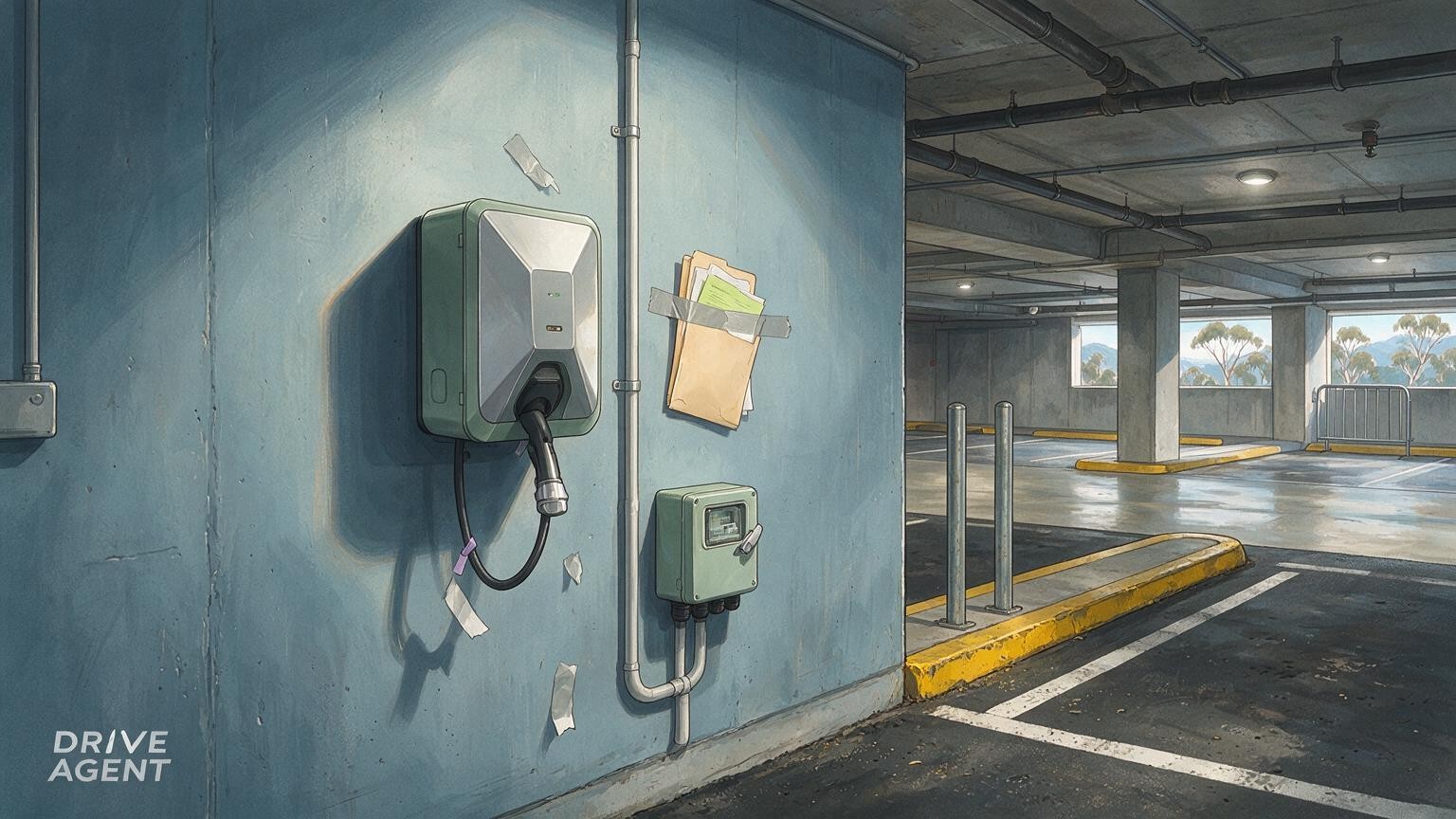
New South Wales is closest to giving apartment owners an explicit statutory right to install an EV charger. Under the Strata Schemes Legislation Amendment (Miscellaneous) Bill, introduced in November 2025, an owner would send the strata committee a written installation notice; the committee would then have three months to object in writing on reasonable grounds, and approval would be deemed granted if it does not respond. The owner would pay every cost and cover any damage to common property, and a plain 10A or 15A power point in the owner's car space would count as a charging installation, not just a 7 kW wallbox. According to Gridly's state-by-state guide, the bill passed the Legislative Assembly and was still before the Legislative Council as of October 2026 — so it is not yet law. 1
Mission Green Energy, in its August 2026 guide, reports the same mechanism and stresses that a number of articles describe the reform as already in force when it is not: as at August 2026 the bill had passed the Assembly, sat before the Council and had not been assented to. Its advice is to plan applications against the rules that exist today and treat the reform as an improvement that may land during the process rather than a right that can currently be asserted. 2
The bill also requires that any objection be reasonable and put in writing, rather than allowing refusals to sit unaddressed. Evibe, in its guide to charging in apartments and rentals, frames the change as making refusal harder for strata committees from 2026 once passed. 5
What is already law in NSW
Two protections are already in force regardless of the bill's fate. EV charging infrastructure is classified as sustainability infrastructure under section 132B of the Strata Management (NSW) legislation — introduced by the 2021 sustainability amendments — which lowers the approval threshold from a 75 per cent special resolution to a simple majority, so a sustainability infrastructure resolution passes unless 50 per cent or more of the vote value is against it. Mission Green Energy notes this difference can decide the outcome in buildings where a vocal minority opposes EVs. 24
Since 1 July 2025, owners corporations in NSW can no longer refuse a charger installation on aesthetic grounds alone, unless the building is heritage-listed or in a heritage area. Mission Green Energy summarises the change as meaning 'it'll look untidy' is no longer a sufficient reason. Also since that date, where a strata committee decides a minor renovation application for wiring, cabling and power points, it must give written reasons for a refusal within three months or the work is automatically approved. 21
Individual owners in NSW also have two existing routes under the Strate Schemes framework: a minor renovation approval by ordinary resolution, or a common property rights by-law requiring a special resolution. If the owners corporation unreasonably refuses, the owner can apply to the NSW Civil and Administrative Tribunal (NCAT) for an order — a route Mission Green Energy calls real rather than theoretical, but costly in time, making it a fallback rather than a plan. 12
Separately, the NSW EV Ready Buildings grant, which funded feasibility studies and up to 80 per cent of retrofit costs for apartment buildings, closed to applications in December 2023, and Gridly reports no new round had been announced as of October 2026. 1
How the other states compare
Gridly's guide finds no Australian state yet gives apartment owners an outright right to install a charger, but the ACT comes closest: 2023 amendments to the Unit Titles (Management) Act 2011 stop owners corporations and building managers from blocking sustainability infrastructure — which the ACT Government says includes EV chargers — without good reason, and consent must not be unreasonably withheld. Queensland requires body corporate approval, with the committee able to approve chargers under $3,000 that are appearance-neutral, and a duty to act reasonably, with disputes going to the BCCM Commissioner and QCAT. 1
On Victoria there is a conflict in the reporting. Gridly states Victoria has no right-to-install protection for EV chargers and no bill before Parliament, with most common-property electrical works approved by ordinary resolution. Evibe, however, claims Victoria's owners corporations law already prevents unreasonable refusal of a lot owner's charger request. Daily Energy News describes Victoria instead relying on guidance: all new apartment buildings must be EV-ready under the National Construction Code 2022 since 1 May 2024, and in August 2026 the state department released an 'EV-ready guide for owners corporations' covering technical assessment, the 'benefit principle' for cost allocation and legal approvals. Readers in Victoria should confirm the current legal position with their owners corporation or the state regulator before relying on either framing. 153
Western Australia, South Australia, Tasmania and the Northern Territory have no EV-specific strata provisions, according to Gridly, which says the quality of the application and the make-up of the committee matter more in those states than anywhere else. 1
For new buildings nationally, the National Construction Code 2022, administered by the Australian Building Codes Board, requires common areas of new apartment buildings to be EV-ready, including dedicated electrical distribution boards — typically one board per 24 parking spaces. ReadySteadyPlug notes this makes older buildings the retrofit challenge, since they were never wired with EV charging in mind. 4
What the changes mean for owners and renters
Under the bill's proposed deemed-approval mechanism, the practical burden shifts to committees to object within three months on written, reasonable grounds — a significant change from open-ended committee discretion. Mission Green Energy estimates roughly four to ten weeks for a straightforward NSW application from notice to approval where the committee responds promptly, longer where a general meeting is required, and warns that missing an annual general meeting deadline can add months. 2
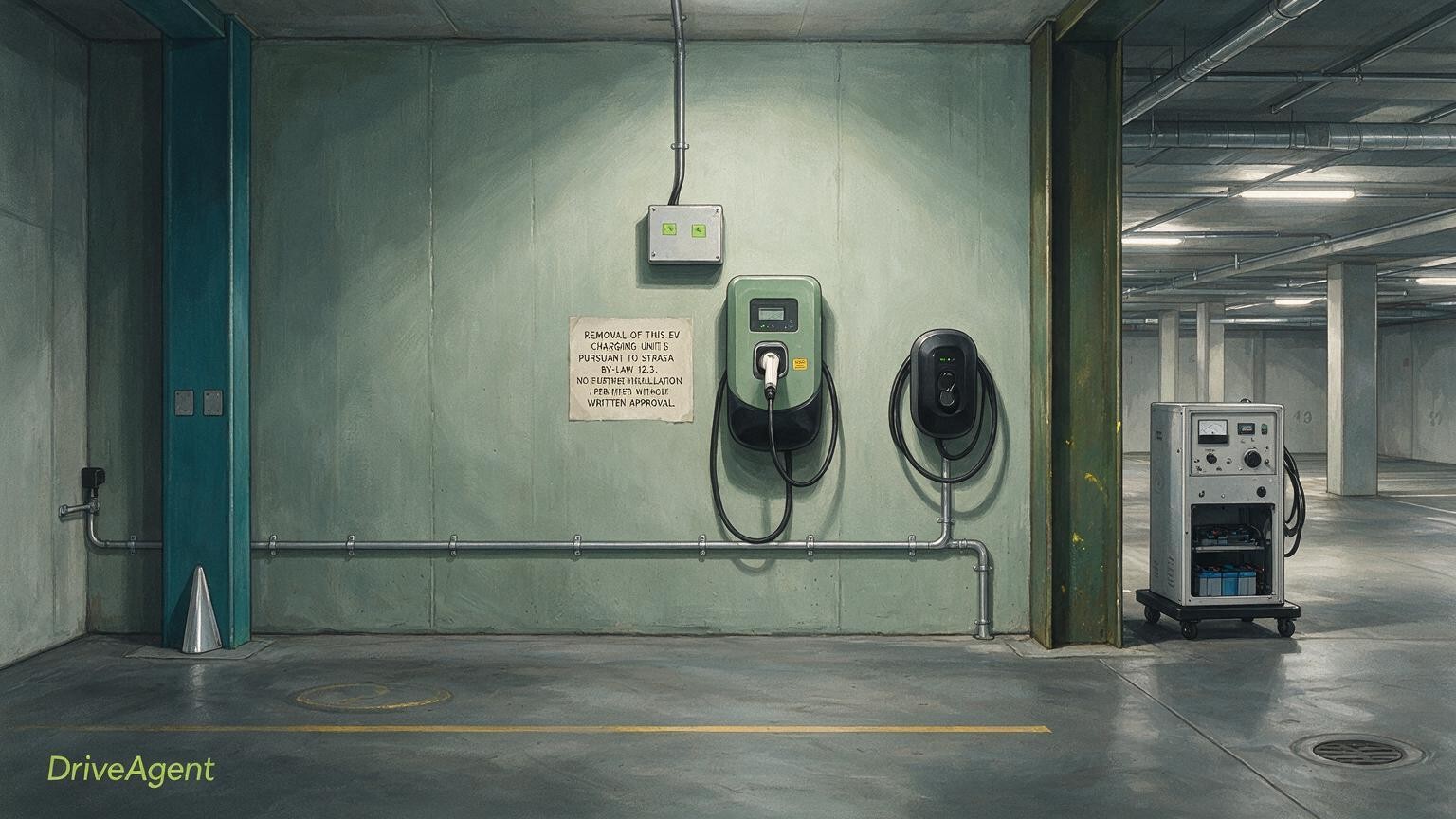
Committee concerns concentrate on three issues, Mission Green Energy argues: who pays for the electricity, whether the building's supply can cope as more residents follow, and who carries liability. Its recommended answers are a dedicated meter or sub-meter billed to the owner, a licensed electrician's load assessment with headroom for others plus a load-management proposal, and written confirmation of licensed installation, certification, insurance and maintenance responsibility. ReadySteadyPlug describes dynamic load management as software that monitors the building's total electrical load and adjusts charging speeds automatically, allowing more chargers to operate than a naive sum of rated charger wattages would suggest. 24
Renters are not covered by any of these reforms. Evibe states none of the current or pending changes create a right for a tenant to install a charger: landlord consent is still required everywhere, and in practice the landlord usually has to make the owners corporation application. Mission Green Energy suggests renters offer to fund the installation as a permanent improvement, agree in writing who owns the hardware at the end of the lease, and in the meantime use a portable cable into an existing power point — roughly 10 to 15 km of range per hour, and never through an extension lead. 52
On costs, Daily Energy News reports the average residential EV charger installation in Australia, including hardware and basic installation, was $2,237 as of July 2026, with charger hardware typically $1,000–$2,500, while shared building infrastructure such as switchboard upgrades and cable trays generally falls to the owners corporation, estimated at $5,000 to $50,000 or more depending on the building. Daily Energy News also lists support such as the City of Sydney Green Building Grant of up to $50,000 for charging feasibility studies and infrastructure, with 2026-round applications closing on 1 September 2026, and ARENA funding of $1.5 million to NOX Energy to deploy 2,000 charging plugs across at least 16 apartment buildings nationwide. 3
Fire-safety objections and insurance
Fire-safety concerns come up at many committee meetings. The Electric Vehicle Council's 2025 strata guidance states that the fire-safety concerns sometimes raised about EVs and their charging infrastructure are not evidence-based, and ReadySteadyPlug reports the Australian Building Codes Board reached the same conclusion — that global evidence indicates EVs are much less likely to be involved in a fire than petrol and diesel vehicles, attributed to battery management systems, manufacturing safety standards and the absence of large volumes of flammable liquids. On insurance, ReadySteadyPlug cites the EVC's observation that several member organisations have installed EV charging with no change to the property's risk profile or premiums, and strata insurer CHU has confirmed that allowing EV charging does not lead to rate or risk changes, according to Daily Energy News. ReadySteadyPlug adds that a managed system with individual metering and load management is lower-risk than residents running extension leads to unmanaged power points. 43
Outlook
The bill's progress is the key variable for NSW apartment owners. It passed the Legislative Assembly and was before the Legislative Council as of October 2026; whether it passes in its current form, and when any provisions would commence, has not been confirmed in the available reporting. Mission Green Energy's advice to plan against the rules in force today — simple-majority sustainability infrastructure resolutions, the ban on aesthetic-only refusals and the NCAT backstop — remains the practical position until the bill is assented to. Meanwhile, Daily Energy News reports EVs took 16.4 per cent of new vehicle sales in the first half of 2026, more than doubling their share from the same period in 2025, with over 410,000 EVs on Australian roads, keeping pressure on the apartment-charging question. 23
AI evidence finder
Ask about this article
Ask a question to find relevant published passages and source links. AI selects evidence; the passages remain exactly as published.
Behind this report
Sources & context
Cited source mix
5 cited pages across 5 websites
- Role not assessed 5
Website breakdown
- dailyenergynews.com.au1 page
- evibe.au1 page
- gridly.com.au1 page
- missiongreen.com.au1 page
- readysteadyplug.com.au1 page
5 cited pages with an undocumented publisher role. Websites may share ownership or repeat the same reporting.
Saved research extracts
5 / 5 cited pages with saved extracts
2 shortened at our text limit · 0 without a saved-extract record
Extracts retrieved 26 Oct 2026.
Extracts can omit page content. These counts do not verify claims or measure independent reporting. Political leaning and reliability are not rated.
- Strata EV Charger Australia 2026 | GridlyRole not assessedShortened extract saved
Why these labels?Strata EV Charger Australia 2026 | Gridly
Who produced it
We have not documented this publisher’s role. An unassigned label is not a negative rating.
How this report uses it
Cited in 7 paragraphs: What the bill would change; What is already law in NSW; How the other states compare.
This describes its use in our report. It does not establish the source’s editorial stance or independently corroborate every claim.
Evidence record
Text retrieved 26 Oct 2026. The retained extract was cut to our text limit; omitted material has not been assessed here.
- EV Charging in an Apartment or Strata Building (2026)Role not assessedSource extract saved
Why these labels?EV Charging in an Apartment or Strata Building (2026)
Who produced it
We have not documented this publisher’s role. An unassigned label is not a negative rating.
How this report uses it
Cited in 8 paragraphs: What the bill would change; What is already law in NSW; What the changes mean for owners and renters; Outlook.
This describes its use in our report. It does not establish the source’s editorial stance or independently corroborate every claim.
Evidence record
Text retrieved 26 Oct 2026. The retained extract did not reach our text limit. Extraction can still omit page content.
- EV Charging for Apartments in Australia 2026: Navigating New ...Role not assessedSource extract saved
Why these labels?EV Charging for Apartments in Australia 2026: Navigating New ...
Who produced it
We have not documented this publisher’s role. An unassigned label is not a negative rating.
How this report uses it
Cited in 4 paragraphs: How the other states compare; What the changes mean for owners and renters; Fire-safety objections and insurance; Outlook.
This describes its use in our report. It does not establish the source’s editorial stance or independently corroborate every claim.
Evidence record
Text retrieved 26 Oct 2026. The retained extract did not reach our text limit. Extraction can still omit page content.
- Strata EV Charging 2026: The Complete Guide For Apartment ...Role not assessedShortened extract saved
Why these labels?Strata EV Charging 2026: The Complete Guide For Apartment ...
Who produced it
We have not documented this publisher’s role. An unassigned label is not a negative rating.
How this report uses it
Cited in 4 paragraphs: What is already law in NSW; How the other states compare; What the changes mean for owners and renters; Fire-safety objections and insurance.
This describes its use in our report. It does not establish the source’s editorial stance or independently corroborate every claim.
Evidence record
Text retrieved 26 Oct 2026. The retained extract was cut to our text limit; omitted material has not been assessed here.
- EV charging for apartments and rentals: what you can actually do in ...Role not assessedSource extract saved
Why these labels?EV charging for apartments and rentals: what you can actually do in ...
Who produced it
We have not documented this publisher’s role. An unassigned label is not a negative rating.
How this report uses it
Cited in 3 paragraphs: What the bill would change; How the other states compare; What the changes mean for owners and renters.
This describes its use in our report. It does not establish the source’s editorial stance or independently corroborate every claim.
Evidence record
Text retrieved 26 Oct 2026. The retained extract did not reach our text limit. Extraction can still omit page content.
Keep reading
Related subjects and more from this section.

Polestar Australia wants a road-user charge for all drivers, not just EV owners
Polestar Australia's managing director says a proposed federal road-user charge should be levied on every motorist, with the fuel excise reviewed rather than scrapped, as the government continues design work on the tax.