Safety advocates press Australia to force carmakers to bring back dashboard buttons as touchscreen distraction evidence mounts
The Australasian College of Road Safety wants a formal review of vehicle standards, backed by Allianz research suggesting distraction contributes to up to one in three crashes, while ANCAP and Euro NCAP now penalise cars that bury critical controls in touchscreen menus.
Synthesised from the cited sources. Research, writing and factual checks are automated using AI. Verify details against the sources. How we produce these reports
Road safety groups call for a standards review
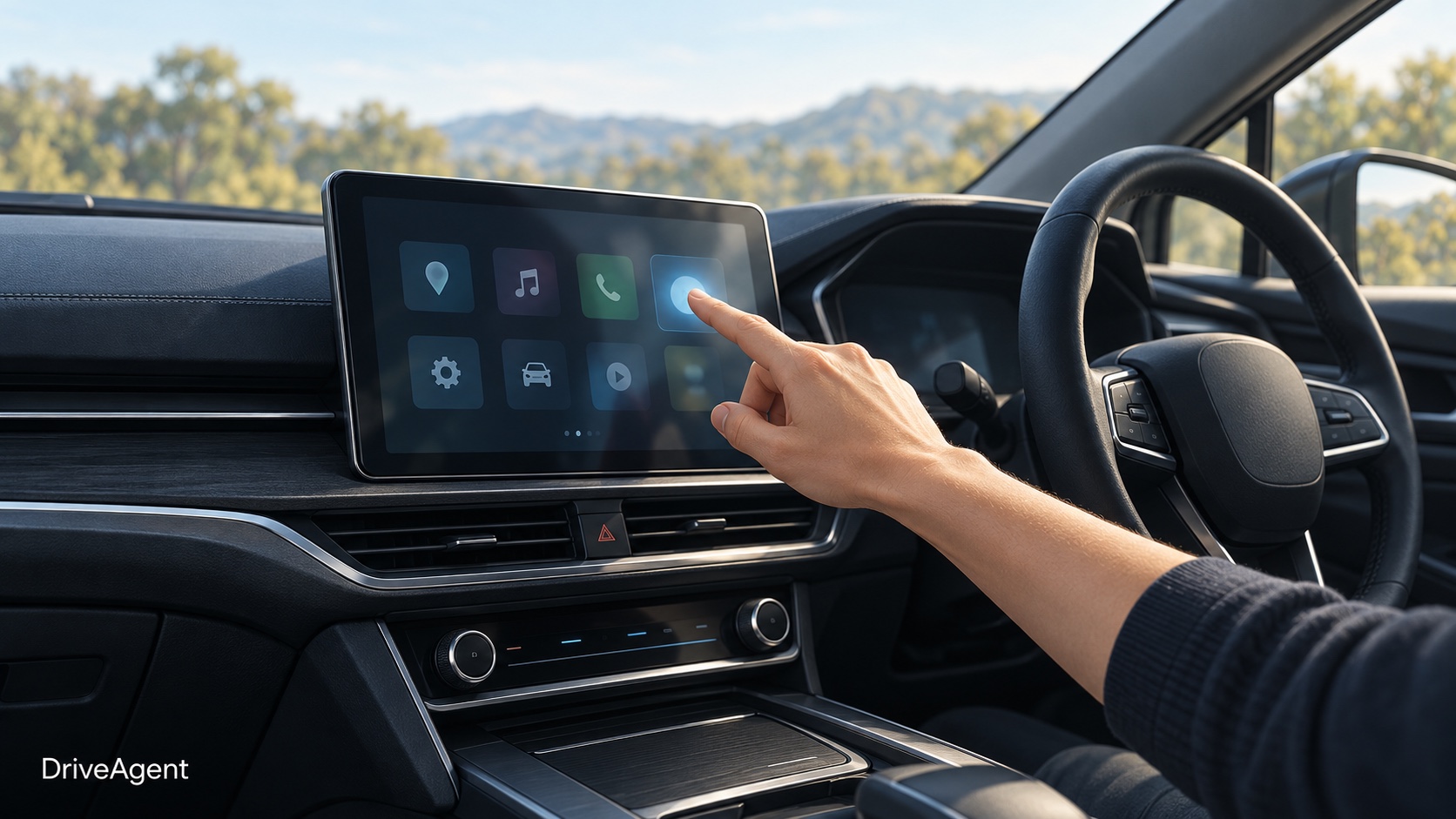
Road safety advocates are pressing the federal government to consider forcing manufacturers to reintroduce physical buttons and dials for common and critical functions, arguing that increasingly complex touchscreen consoles are distracting drivers and contributing to crashes. The call from the Australasian College of Road Safety comes as insurer Allianz separately pushes automakers and authorities in all jurisdictions to take the distraction risk in modern vehicles more seriously. 12
Dr Ingrid Johnston, chief executive of the ACRS, said there is now “a strong case for Australian authorities to review whether existing vehicle safety standards adequately address the distraction risks associated with modern touchscreen interfaces”. She argued current rules do not comprehensively assess the distraction or complexity of operating in-vehicle systems, and that any updated requirements should consider the number of interactions needed for common tasks, the time drivers spend looking away from the road, and whether complex functions should be restricted while driving. 12
“ACRS would support consideration of stronger, evidence-based requirements, including whether frequently used or safety-critical functions should have physical controls or other interfaces that remain readily accessible without requiring prolonged visual attention,” Johnston said. Her comments were reported by The Age and The Sydney Morning Herald, whose national consumer affairs reporter Elias Visontay wrote the article published on 22 October 2026. 12
What the Allianz research and Australian testing found
Allianz, in calling for stricter design rules, pointed to research it commissioned comprising a review of 80 studies on driver distraction, new experiments using retina-tracking technology in real vehicles, and analysis of claims data and more than 34,000 injury-causing crashes since 1999. The review reassessed historical crashes for additional indicators of distraction, such as a lack of braking or evasive action. While distraction is recorded as the cause in just 1.4 per cent of crashes, Allianz now believes it contributes to as many as one in three road crashes. 12
The insurer’s survey of 1200 Australian motorists found 75 per cent believe in-vehicle technology distractions have increased in recent years, with 41 per cent rating the risk as high or very high. About 29 per cent of respondents said they had experienced a critical situation — hard braking, a near miss or a crash — while using a vehicle touchscreen, and one in five drivers surveyed reported causing or partly causing a crash in the past three years, with 67 per cent of those saying distraction definitely or possibly played a role. 12
The review also assessed how a distracted driver’s performance compared with an intoxicated driver, finding that in certain scenarios such as on rural roads, a two-second glance away from the road can be more dangerous than a 0.08 blood alcohol content, according to the review as quoted by The Age. Separately, testing conducted by the University of Newcastle for the Australian Automobile Association found the most poorly designed menus demand up to 11 taps to perform functions such as changing air conditioning or entering a navigation destination, costing six seconds of visual attention — at 60 km/h, a driver travels about 100 metres blind in that time. 12
Michael Regan, an emeritus professor at the University of NSW who oversaw Allianz’s findings, was blunt about newer-generation cars that require a touchscreen to adjust side mirrors, air conditioning and the radio. “It’s madness because it’s extremely distracting,” he said, adding that research shows drivers who take their eyes off the road typically miss traffic signs, signals and subtle changes, and take longer to react to danger. He cited studies finding that when a driver looks away for more than two seconds, crash risk doubles, rising exponentially with every additional second. 12
The regulatory gap and ANCAP’s new protocols
A central concern is that functions once performed by touch alone now require drivers to look away from the road. Australian law forbids holding a mobile phone and severely restricts touching a legally mounted phone, but rules governing integrated touchscreens are vague: displaying video in motion is banned, yet broader careless driving laws do not specifically address distraction linked to in-car controls. 12
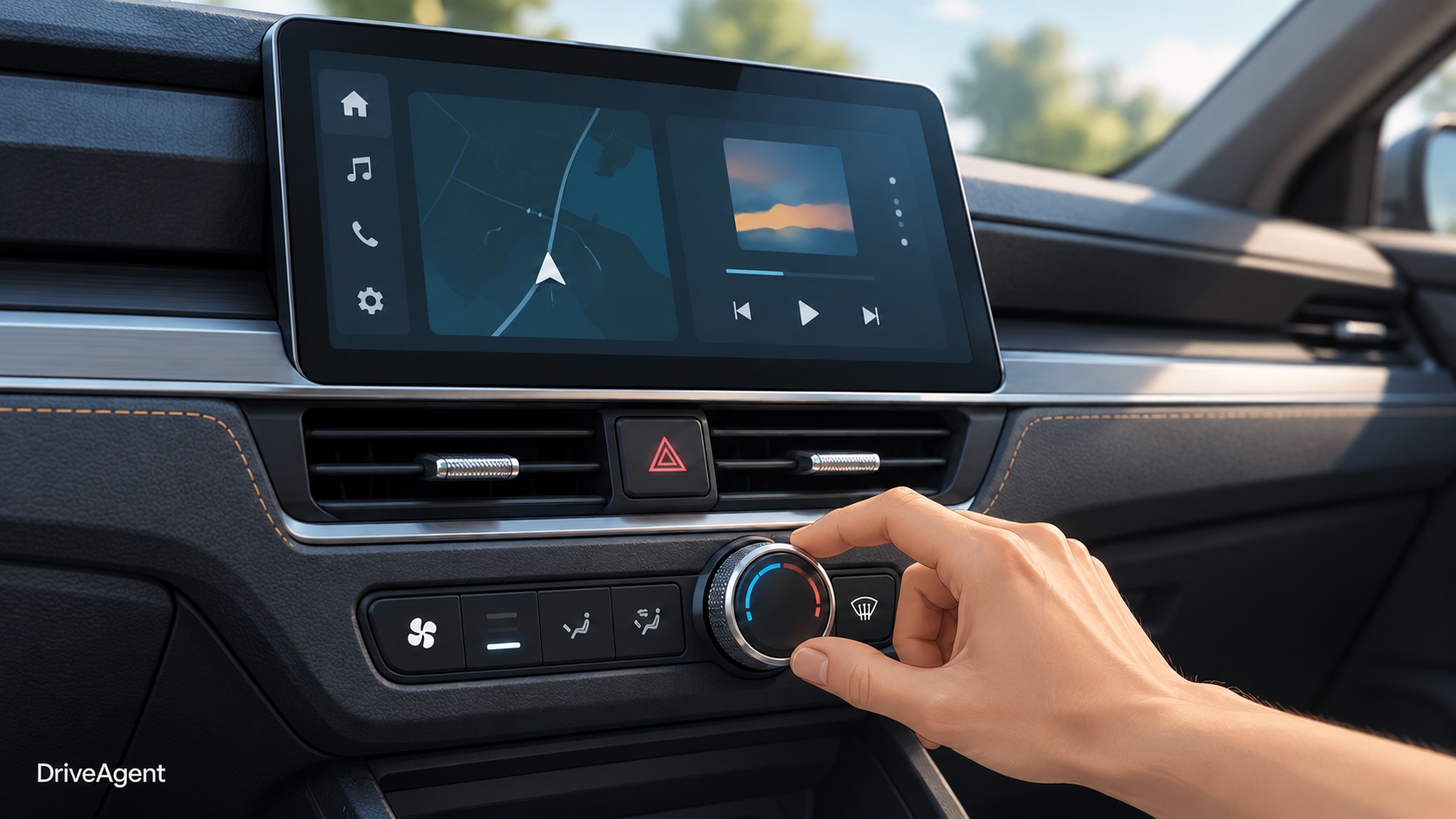
As of this year, the Australasian New Car Assessment Program has aligned with its European counterpart with protocols that penalise over-reliance on touchscreen menus. A manufacturer now loses points if it does not provide either a physical button or stalk, or a permanently dedicated section of a touchscreen, to engage indicators, hazard lights, windscreen wipers, headlights and sound the horn. However, a car penalised for distracting controls can recoup points in other areas and still achieve a five-star overall rating. 12
Poor ANCAP ratings do not ban cars from the market. For Australia to follow China’s path — where authorities announced earlier this year that new cars sold domestically will require physical buttons for critical controls from mid-2027 — the government would need to update the Australian Design Rules that set mandatory standards for all new vehicles. That requirement does not apply to China’s export market, but it is expected to shape vehicle design out of China. 12
Industry and government resist acting alone
Whether manufacturers would accept stricter design rules is unclear. Tony Weber, chief executive of the Federal Chamber of Automotive Industries, told The Age that Australia acting ahead of other jurisdictions could harm local supply and cost. “International harmonisation ensures Australians benefit from globally developed vehicle safety standards. Introducing additional Australian requirements could increase complexity and cost for consumers,” he said. 12
A spokeswoman for Transport Minister Catherine King likewise noted the importance of international harmonisation for Australian Design Rules, given the nation’s reliance on vehicle imports, while stating that the government “is continually adding to or amending Australian Design Rules (ADRs) based on changing vehicle technology and road safety risks”. 12
Overseas ratings show a split between European and Chinese brands
The safety debate is playing out in overseas crash-testing results. Euro NCAP, which introduced this year the criteria ANCAP has matched, requires controls including indicators, wipers and washers, hazard lights, the horn and the eCall emergency button to be operable by a single button under its Safe Driving section, with points deducted for failure. In evaluations of three new models’ cabin controls, the body scored the Audi Q7 90 per cent for driving-control usability and described its controls as “simple, intuitive and ultimately safe”, while the Kia EV2 also achieved excellent results. The Chinese XPeng X9, by contrast, was judged to “rely too heavily on the central touchscreen, which can be distracting”, scoring just 20 per cent. 4
Euro NCAP said the latest round of assessments shows established manufacturers “making a steady return in favour of buttons and switches”, with BMW’s iX3 scoring a perfect 100 per cent for driving controls and the Cupra Raval 80 per cent, while the Zeekr 7GT and Aion UT each received 20 per cent and the Leapmotor B05 scored zero. Programme director Dr Aled Williams said the results show the XPeng “adheres to the mantra that everything must be included in the touchscreen, despite overwhelmingly negative feedback by European car buyers”, and applauded Audi and Kia for “keeping safety simple”. These ratings and prices — from £82,500 for the Q7 to £24,000 for the EV2 — are UK-market figures published by Euro NCAP via the Daily Mail’s coverage, and do not establish Australian specifications. 4
The wider evidence on screens and distraction
The evidence base extends beyond the current Australian debate. The Conversation, in a January analysis of human factors research, cited a 2020 UK study by independent research company TRL in which drivers completed simulated motorway drives while using touchscreen systems including Apple CarPlay and Android Auto; reaction times increased markedly, lane-keeping deteriorated, and in some cases touchscreen interaction was as distracting as — or more distracting than — texting while driving or a handheld phone call. The article also noted a large meta-analysis of 43 studies showing voice interaction, while slightly better than visual-manual systems, still worsens driving performance compared with driving with no secondary task. 3
Consumer frustration features too. The Conversation cited a survey of 92,000 US buyers showing infotainment systems generate more complaints in the first 90 days of ownership than any other vehicle system. Locally, motoring body RAA, in its sa move magazine, noted an eye-tracking study by Norwegian research company SINTEF finding that simple touchscreen tasks such as adjusting temperature caused drivers to divert their gaze for as much as two full seconds — about 33 metres travelled at 60 km/h — and argued physical buttons rely on muscle memory, give immediate feedback and work with gloves and in varied lighting. 35
The history of in-car screens also informs the debate. RAA’s magazine traced the first digital car touchscreen to the 1986 Buick Riviera, whose Graphic Control Centre was discontinued by 1990 after customers complained it was too distracting. It also reported that Mercedes-Benz, which unveiled a 1.41-metre pillar-to-pillar display in 2021, is now dialling back its all-digital interior over distraction complaints, with the company’s Chief Software Officer Magnus Östberg publicly acknowledging physical controls are often safer and more effective. 5
AI evidence finder
Ask about this article
Ask a question to find relevant published passages and source links. AI selects evidence; the passages remain exactly as published.
Behind this report
Sources & context
Cited source mix
5 cited pages across 5 websites
- News publisher 1
- Role not assessed 4
Website breakdown
- dailymail.com1 page
- samove.raa.com.au1 page
- smh.com.au1 page
- The Agetheage.com.au1 page
- theconversation.com1 page
4 cited pages with an undocumented publisher role. Websites may share ownership or repeat the same reporting.
Saved research extracts
5 / 5 cited pages with saved extracts
0 shortened at our text limit · 0 without a saved-extract record
Extracts retrieved 22 Oct 2026.
Extracts can omit page content. These counts do not verify claims or measure independent reporting. Political leaning and reliability are not rated.
- ‘It’s madness’: Safety fears prompt calls to bring back buttons on car dashboardsNews publisherSource extract saved
Why these labels?‘It’s madness’: Safety fears prompt calls to bring back buttons on car dashboards
Who produced it
Nine identifies The Age as its newspaper and digital news publication. Identity reference ↗
How this report uses it
Cited in 12 paragraphs: Road safety groups call for a standards review; What the Allianz research and Australian testing found; The regulatory gap and ANCAP’s new protocols; Industry and government resist acting alone.
This describes its use in our report. It does not establish the source’s editorial stance or independently corroborate every claim.
Evidence record
Text retrieved 22 Oct 2026. The retained extract did not reach our text limit. Extraction can still omit page content.
- Safety fears prompt calls to bring back buttons on car ...Role not assessedSource extract saved
Why these labels?Safety fears prompt calls to bring back buttons on car ...
Who produced it
We have not documented this publisher’s role. An unassigned label is not a negative rating.
How this report uses it
Cited in 12 paragraphs: Road safety groups call for a standards review; What the Allianz research and Australian testing found; The regulatory gap and ANCAP’s new protocols; Industry and government resist acting alone.
This describes its use in our report. It does not establish the source’s editorial stance or independently corroborate every claim.
Evidence record
Text retrieved 22 Oct 2026. The retained extract did not reach our text limit. Extraction can still omit page content.
- Yes, those big touchscreens in cars are dangerous and ...Role not assessedSource extract saved
Why these labels?Yes, those big touchscreens in cars are dangerous and ...
Who produced it
We have not documented this publisher’s role. An unassigned label is not a negative rating.
How this report uses it
Cited in 2 paragraphs: The wider evidence on screens and distraction.
This describes its use in our report. It does not establish the source’s editorial stance or independently corroborate every claim.
Evidence record
Text retrieved 22 Oct 2026. The retained extract did not reach our text limit. Extraction can still omit page content.
- Chinese cars are touchscreen heavy and more distracting to drive than European rivalsRole not assessedSource extract saved
Why these labels?Chinese cars are touchscreen heavy and more distracting to drive than European rivals
Who produced it
We have not documented this publisher’s role. An unassigned label is not a negative rating.
How this report uses it
Cited in 2 paragraphs: Overseas ratings show a split between European and Chinese brands.
This describes its use in our report. It does not establish the source’s editorial stance or independently corroborate every claim.
Evidence record
Text retrieved 22 Oct 2026. The retained extract did not reach our text limit. Extraction can still omit page content.
- Why buttons are back | sa move The RAA magazineRole not assessedSource extract saved
Why these labels?Why buttons are back | sa move The RAA magazine
Who produced it
We have not documented this publisher’s role. An unassigned label is not a negative rating.
How this report uses it
Cited in 2 paragraphs: The wider evidence on screens and distraction.
This describes its use in our report. It does not establish the source’s editorial stance or independently corroborate every claim.
Evidence record
Text retrieved 22 Oct 2026. The retained extract did not reach our text limit. Extraction can still omit page content.
Keep reading
Related subjects and more from this section.
NZ workshops point to Australia's right-to-repair scheme as both major parties back reform
New Zealand's independent workshop leaders have set out what they need from right-to-repair legislation ahead of the election, citing Australia's information-sharing scheme as proof that repair access and manufacturer intellectual property can coexist.