Supercars Legends / Australian
Bob Jane
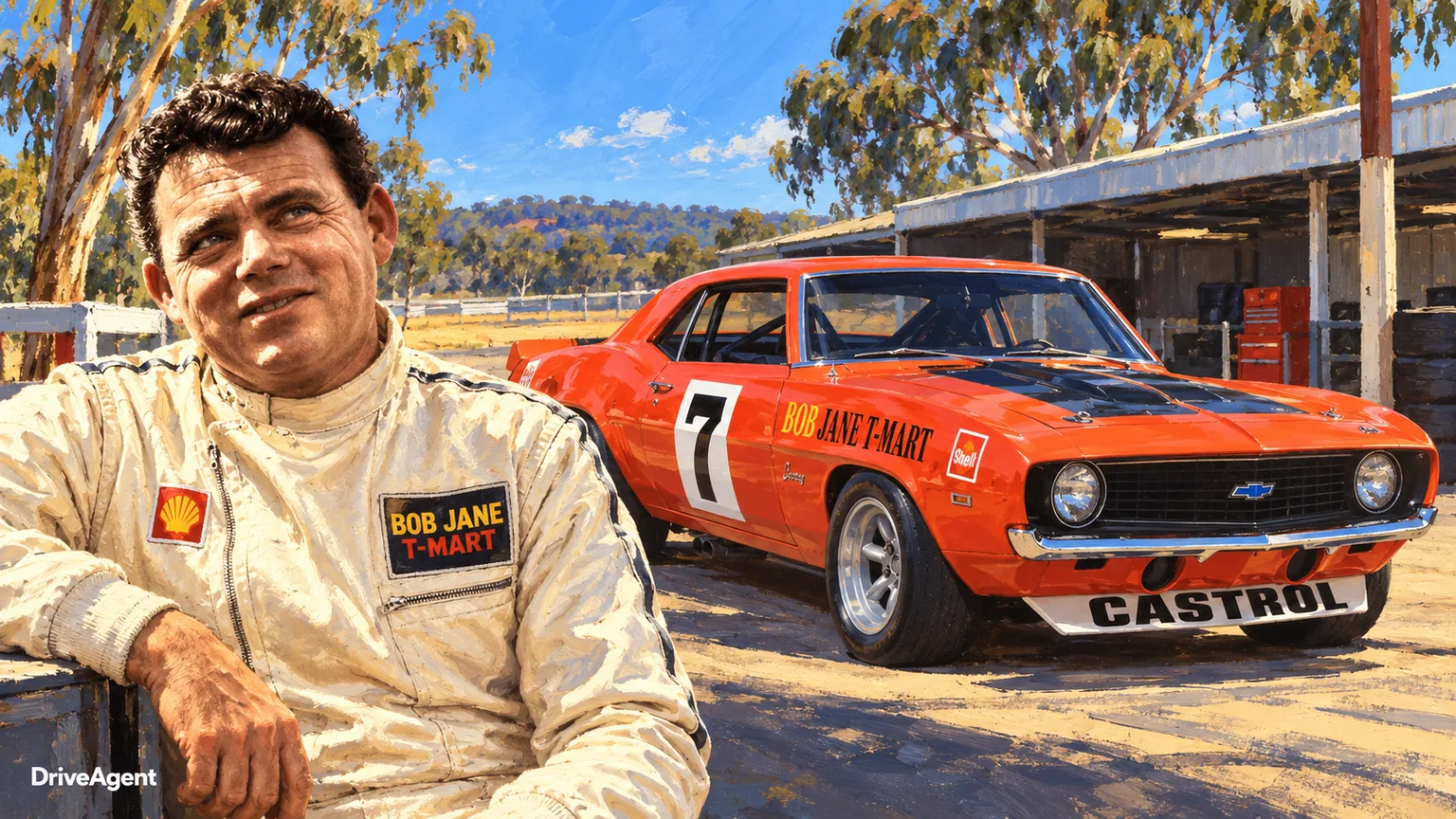
Bob Jane’s Camaro survived Allan Moffat’s late charge and an extraordinary track intrusion to secure the 1971 title. A smaller engine presented a new challenge when he defended it.
By DriveAgent News · Historical profile · Records checked
The biography
Jane’s championships came in two pairs: 1962–1963 in Jaguars and 1971–1972 in a Chevrolet Camaro. His influence continued through the tyre industry and race promotion, connecting the workshop, the showroom and the circuit.
Wins and accolades
Jane won four Australian Touring Car Championships: 1962 and 1963 with Jaguar, then 1971 and 1972 in a Chevrolet Camaro. Supercars inducted him into its Hall of Fame in 2000. Those two pairs of titles spanned the change from a single deciding race to a multi-round championship.
Sources: [1]
The stakes: three drivers, one championship
Oran Park’s 1971 finale began with Jane on 34 points, Ian Geoghegan on 32 and Allan Moffat on 31. Nine points for victory left all three in contention. Jane had recovered from an opening-round spin to finish second, suffered a retirement at Calder and won at Sandown after Moffat was disqualified for ignoring black flags over loose bodywork.
Moffat took pole for the final race and led at the start. Jane’s advantage in the table was small enough that the decisive contest had to be settled on the track.
Sources: [5]
Race report: the Camaro holds on at Oran Park
Moffat led the opening 15 laps before his Mustang’s gearbox stuck in second. Jane and Geoghegan passed while he dealt with the problem. Once moving properly again, Moffat regained second place and began reducing the Camaro’s advantage.
An extraordinary hazard then entered the race: a spectator drove a road-going Valiant Pacer onto the circuit. Both leaders got past without a collision. Moffat continued his pursuit, but Jane reached the flag ahead; Supercars’ retrospective describes a finishing gap of two car lengths.
Jane won the race and the title. The mechanical interruption created his opportunity, but it did not end the contest: he still had to withstand the recovered Mustang’s closing challenge.
Sources: [6]
The next challenge: win again with less engine
The 1971 Camaro used a 427-cubic-inch aluminium V8. A rule change removed that option for 1972, forcing Jane to defend the championship with a 350-cubic-inch engine. He won four of the eight rounds and retained the title.
That second Camaro crown is an important answer to the idea that the achievement rested entirely on the bigger engine. The regulations changed the machinery available to him, and the revised car still delivered a championship. It was Jane’s fourth and final ATCC title.
Sources: [4]
Four endurance wins, with the venues kept clear
Jane’s consecutive Armstrong 500 victories ran from 1961 to 1964. Harry Firth shared the first three; George Reynolds shared the fourth. The first two were at Phillip Island, followed by two at Bathurst after the event moved to Mount Panorama.
His Great Race total is therefore four, while this page’s Bathurst total is two. The sequence linked the early Phillip Island event with the beginnings of the endurance race at Mount Panorama.
Sources: [2]
Legacy in the tyre trade and at the circuit
The company’s own history traces its first tyre shop to Haberfield, Sydney, in 1964, followed by a Melbourne store in 1965. Those businesses preceded the later T-Marts network. Jane’s involvement in Calder Park and race promotion extended his public role after the championship-winning years.
Viewed together, the racing and commercial records explain his place in an automotive publication: Jane was a competitor whose name travelled from the results sheet into everyday motoring. The championships provide the sporting foundation; the business and events explain its wider reach.