Supercars Legends / Australian
Ian Geoghegan
Five titles established Ian “Pete” Geoghegan’s standing. A 0.6-second Bathurst sprint win, a post-race protest and a later endurance victory with his rival reveal the story behind the numbers.
By DriveAgent News · Historical profile · Records checked
The biography
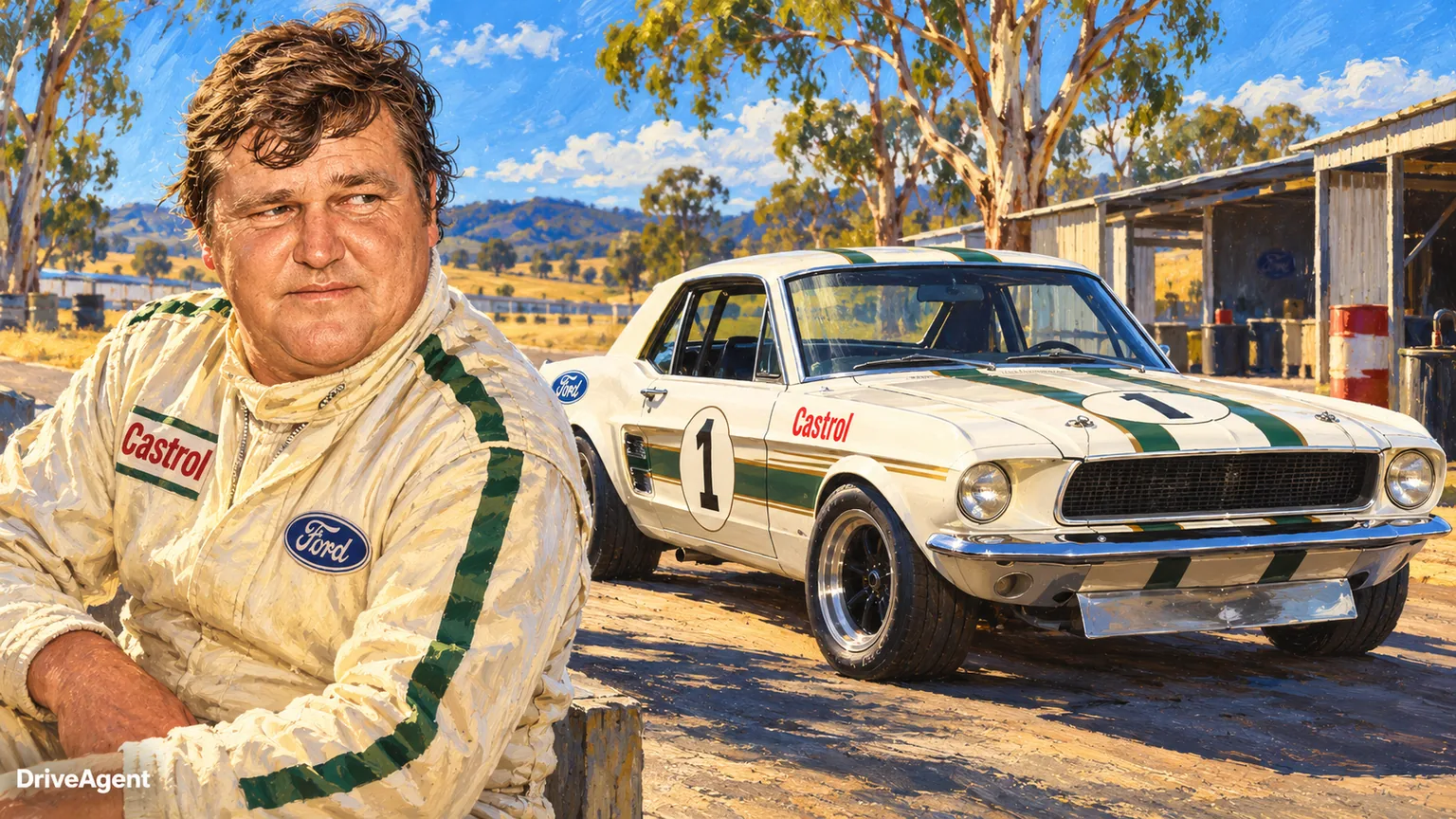
Geoghegan became the first five-time ATCC champion. His titles in 1964 and 1966–1969 bridged the single-race format and the first season-long championship; he later shared the 1973 Bathurst win with Allan Moffat.
Wins and accolades
Geoghegan became the first five-time Australian Touring Car champion, winning in 1964 and then every year from 1966 to 1969. He was one of the Supercars Hall of Fame’s two inaugural inductees in 1999, alongside Allan Moffat.
Sources: [1]
The title decided by the scoring rules
The first season-long ATCC in 1969 produced an unusually fine distinction. Porsche driver Alan Hamilton accumulated the most points across the five races, but each driver had to discard his worst result. On the scores that counted, Geoghegan won the championship by one point.
That was his fourth successive title. The achievement bridged the single-race championship and the new series format, while the Hamilton comparison shows why a raw points sum can tell the wrong story. The championship was decided under the published scoring system, not by adding every result.
Sources: [6]
Race report: Bathurst’s Easter duel, 1972
Geoghegan arrived with an XY Falcon GT-HO whose pace had too often been undermined by unreliability. Moffat’s Mustang started from pole, almost three seconds faster in qualifying. The race lasted 13 laps, on the old Mount Panorama layout before The Chase existed.
The contest became a two-car fight. Jane and Beechey retired with mechanical trouble, while Geoghegan and Moffat lapped the remaining field. Moffat’s late attack down Conrod Straight was not enough: Geoghegan won by 0.6 seconds.
Moffat protested after oil from the Falcon affected his Mustang. Stewards considered the matter for 90 minutes and allowed Geoghegan’s result to stand. Geoghegan’s narrow win survived the post-race challenge.
For Geoghegan, it ended a long wait for another championship race win. For Ford, it delivered the Falcon’s first ATCC victory. It was a sprint-round success, distinct from the October endurance race.
Sources: [5]
A Bathurst disappointment before the breakthrough
Geoghegan had already experienced the difference between crossing the line and receiving the final result. In 1967 he and brother Leo took the chequered flag as apparent winners of the Great Race, but lap-scoring confusion left them classified second.
Six years later the endurance victory became official. Geoghegan shared Ford’s factory XA Falcon with Moffat to win in 1973. The rival he had beaten in the celebrated Easter sprint was now his co-driver. This was the first Bathurst held over 1000 kilometres rather than 500 miles.
What the record tells us
The Cortina and Mustang titles, the Falcon sprint breakthrough and the shared endurance win belong to different chapters. Their significance is clearer when the machinery, rules and circumstances stay attached to each result.
DriveAgent’s reading of that career is one of adaptability: a champion from the single-race era remained competitive through a new championship format and a demanding Falcon programme, then succeeded in partnership with a major rival. The five titles describe sustained success; the 1972 sprint and 1973 endurance victories show his success in very different Bathurst contests.