Supercars Legends / Australian
Norm Beechey
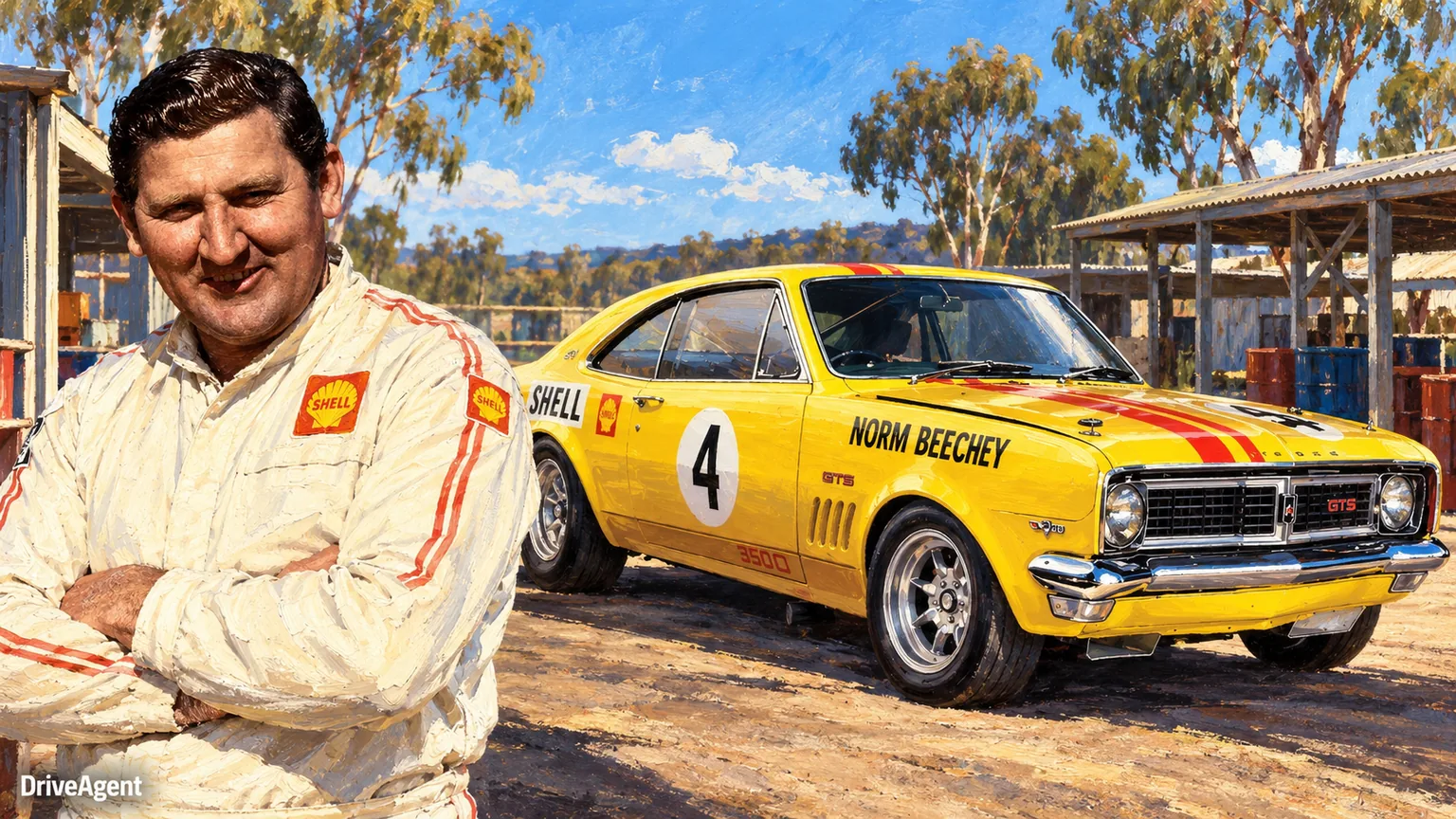
Norm Beechey’s Monaro delivered Holden’s first touring-car title at Lakeside in 1970. The breakthrough followed lost leads, a tyre failure and years of developing different cars.
By DriveAgent News · Historical profile · Records checked
The biography
Known as Stormin’ Norman, Beechey won the ATCC with both Ford and Holden. His second championship was the first for Holden and the first won by an Australian-built car, giving the Monaro a special place in the sport’s history.
Wins and accolades
Beechey won the ATCC in a Ford Mustang in 1965 and a Holden HT Monaro in 1970. The second title was Holden’s first. Supercars records seven championship-round wins from 31 appearances and recognises him as a 2000 Hall of Fame inductee.
Those results crossed an important format change. His Mustang title was settled in a single race; the Monaro had to deliver across a season. Winning in both settings required more than repeating the same successful afternoon with a different badge.
Trials and decisions: the faster car was not always the choice
In Dale Rodgers’ retrospective interview, Beechey’s 1966 defence at Bathurst began with a concrete machinery decision. He had qualified both a Mustang and a Chevrolet Nova. Although his Mustang was quicker in qualifying, he chose the newer Nova and led the race before gearbox oil reached the clutch. Geoghegan passed and won.
Lakeside brought another lost opportunity in 1967. Leading again in the Nova, Beechey suffered a tyre failure and hit the barrier with ten laps remaining. The later Monaro success followed repeated demonstrations that speed alone did not guarantee the championship.
Sources: [8]
Building the Holden challenge
The same interview traces the HT Monaro’s preparation to Beechey’s Brunswick workshop, with Lou Mallia overseeing the build. It began as a road car and became a racing challenger while the team was moving on from the earlier HK.
The engineering story matters alongside the driver’s reputation for spectacular racing. The championship-winning Holden was the product of preparation and development, competing against established imported machinery. It did not arrive at Lakeside with a result already assured.
Sources: [8]
Race report: Lakeside, 1970
Beechey reached the penultimate round with victories at Bathurst and Sandown already recorded. Winning at Lakeside would secure the championship. The National Film and Sound Archive’s Australian Screen description of Championship Chase records an early crash, Beechey moving into the lead and Bob Jane briefly challenging in a Mustang.
Beechey then won comfortably. Establishing the lead and surviving Jane’s challenge delivered the result he needed. The Monaro’s Lakeside victory secured the championship with one round still to run.
The race sequence is described in Australian Screen’s account of Championship Chase, a contemporary Shell-sponsored documentary preserved by the National Film and Sound Archive. Its sponsor’s perspective is part of the context; the championship result is corroborated by Supercars’ records.
The result, and the Bathurst distinction
The final championship margin was four points over Porsche driver Jim McKeown. Beechey did not start the Symmons Plains finale, which McKeown won, but the title had already been secured at Lakeside. The close final points gap should not be mistaken for a championship decided at the last race.
Sources: [4]
Why the Monaro still matters
Beechey’s 1970 Bathurst win was a championship sprint, separate from the annual endurance event. It remains a major Mountain performance without becoming a Bathurst 500/1000 victory in the career tally.
Sources: [5]
A tribute carried into modern Supercars
Brad Jones Racing honoured Beechey with three retro liveries at Sandown in 2017, recalling his Mustang, Chevrolet Nova and Monaro. The breadth of that tribute captures an important part of the legacy: supporters remembered the driver through several different cars, not a lifelong commitment to one manufacturer.
Sources: [3]